
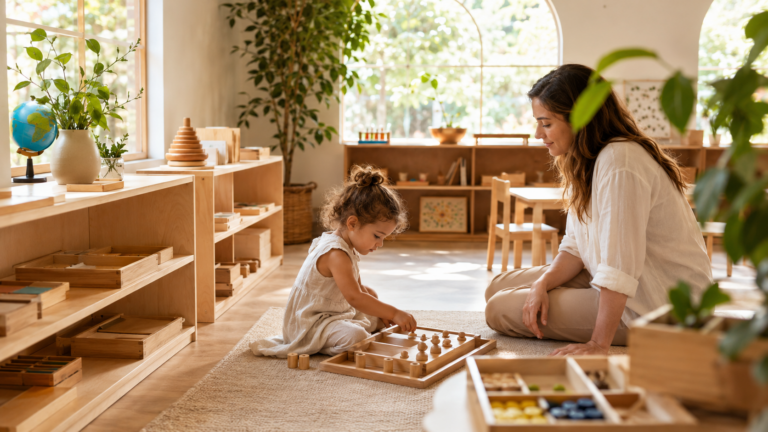
Montessori education is an approach to learning founded by Maria Montessori, an Italian physician and educator, in the early twentieth century. It is based on her careful observation of children and her belief that the most effective way to support learning is to provide a safe, stimulating, and nurturing environment in which children can explore and develop at their own pace.
At its heart, Montessori education is built on the understanding that children are naturally curious and intrinsically motivated to learn. Given the right environment and the freedom to explore, they can reach their full potential – academically, socially, emotionally, and physically.
The Montessori Classroom
In a Montessori classroom, children are encouraged to choose their own activities, work at their own pace, and learn through hands-on exploration. The environment is carefully and intentionally prepared to meet each child’s individual needs and developmental stage.
Teachers in Montessori settings are referred to as guides rather than instructors. Their role is to observe, support, and gently introduce new materials – not to direct every activity or deliver information. This approach fosters deep, self-directed learning rather than passive absorption of content.
Materials Used in Montessori Education
A carefully selected range of materials is central to the Montessori approach. These materials are designed to be:
- Self-correcting – children can identify and resolve their own mistakes without adult intervention
- Hands-on – engaging children through touch, movement, and direct experience
- Purposeful – each material targets a specific developmental skill or concept
- Beautiful – aesthetically designed to invite use and care
Materials include sensorial tools, practical life activities, language and literacy materials, maths manipulatives, and cultural exploration resources. Children are introduced to each material through a gentle, individualised presentation from their teacher.
Core Principles of Montessori Education
Respect for the Child
Montessori education is deeply rooted in respect for the child as a capable, curious, and independent human being. Children’s needs, interests, and developmental stages are honoured rather than overridden.
Collaboration and Cooperation
Children in Montessori environments are encouraged to work together, help one another, and respect their peers. Mixed-age groupings – typically spanning three years – allow older children to mentor younger ones, reinforcing their own learning in the process.
Self-Directed Learning
Freedom of choice is fundamental to the Montessori method. When children are trusted to direct their own learning, they tend to engage more deeply, sustain their focus for longer, and develop a genuine love of discovery.
Independence and Life Skills
Montessori education actively develops practical independence – encouraging children to dress themselves, care for their environment, organise their time, and take responsibility for their own learning. These life skills extend far beyond the classroom.
Why Montessori Education?
The Montessori approach to education is backed by over a century of practice and a growing body of research supporting its effectiveness. Studies have suggested that children educated in Montessori environments may develop stronger executive function, social skills, and a more positive relationship with learning compared to those in traditional educational settings.
Whether you are considering a Montessori school for your child or looking to bring Montessori principles into your home, the underlying philosophy remains the same: trust the child, prepare the environment, and follow their natural drive to learn.
This page is for general informational purposes only; please consult a qualified professional for advice specific to your child’s individual needs.