
Allowing Young Children to Help in the Kitchen: A Montessori Approach
Welcoming young children into the kitchen — as genuine helpers rather than supervised spectators — is one of the most powerful practical life investments a Montessori-inspired family can make. The kitchen offers a uniquely rich learning environment, and children’s desire to be involved in real, meaningful work is one of the strongest motivators in early childhood.
Why the Kitchen Matters in Montessori
Maria Montessori placed great emphasis on practical life activities — those that connect children to the real needs and rhythms of daily life. Food preparation sits at the heart of this: it is real, necessary, repeatable, and directly connected to the well-being of the family. When a child helps stir the soup that the family will eat for dinner, their contribution has genuine meaning.
Making Kitchen Involvement Safe and Accessible
- A learning tower or sturdy step stool — essential for safe counter-height access
- An apron hung at the child’s height — putting it on becomes part of the ritual
- Child-appropriate tools — a small whisk, a Y-peeler, a crinkle cutter, small measuring cups
- A tray or mat for the work area — contains mess and defines the workspace
- A cloth and small basin for cleaning up — part of the activity, not an afterthought
How to Introduce Kitchen Activities
The Montessori approach to presenting any new activity is the same: show slowly, clearly, and with minimal words. Demonstrate the activity once, then invite the child to try. Resist the urge to take over if the result isn’t perfect — the process is what matters.
Activities by Age
12–18 Months
- Washing fruits and vegetables
- Tearing bread, lettuce, or herbs
- Putting ingredients into a bowl
- Stirring
18 Months–2 Years
- Peeling banana or mandarin
- Spreading soft toppings
- Pouring from a small pitcher
- Simple measuring
2–3 Years
- Cracking eggs
- Using a crinkle cutter on soft vegetables
- Measuring dry and wet ingredients
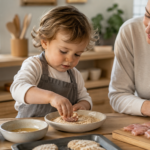
- Kneading simple doughs
- Setting and clearing the table
The Ripple Effects
Children who participate regularly in food preparation tend to develop a broader palate and a more adventurous relationship with food. They also develop a genuine sense of contribution and pride that carries into other areas of their development. The kitchen can become one of the most joyful shared spaces in a Montessori home — even when (especially when) things get a little messy.
This post is for general informational purposes only; please consult a qualified professional for advice specific to your child’s needs.