
Choosing the right school for your child is one of the most important decisions you will make as a parent. When it comes to Montessori, that decision can feel particularly complex – because the term “Montessori” is not trademarked or legally protected, meaning any school can use it, regardless of how closely it follows the original philosophy.
This guide is designed to help you ask the right questions, know what to look for when you visit, and feel confident in your choice.
Why Choosing Carefully Matters
The quality and authenticity of Montessori schools varies considerably. A school may have a beautiful set of Montessori materials from a reputable catalogue – but without properly trained teachers, a genuine understanding of the philosophy, and a thoughtfully prepared environment, the materials alone do not make it a true Montessori school.
The reverse is also true: some excellent Montessori educators work with very modest resources and create deeply authentic Montessori experiences. What matters most is the quality of the teaching, the culture of the environment, and the extent to which the school genuinely follows Montessori principles.
Questions to Ask When Visiting
Teacher Training and Qualifications
- What Montessori certification do the teachers hold? Certifications from reputable training institutions (such as those affiliated with AMI or AMS – see below) typically require significant hands-on training. Be aware that some online-only certifications may not provide the same depth of understanding.
- How many teachers in the classroom are formally Montessori-trained? Ideally, the lead teacher should hold a recognised Montessori qualification for the relevant age group.
- How many years of Montessori experience does the lead teacher have? Experience in the classroom makes a significant difference to the quality of the programme.
- Does the school invest in ongoing teacher professional development? The best Montessori educators are lifelong learners.
School Accreditation and Affiliation
Ask whether the school holds affiliation or accreditation with a recognised Montessori organisation. These bodies inspect and accredit schools to ensure standards and quality are maintained. Key organisations include:
- Association Montessori Internationale (AMI) – founded by Maria Montessori herself in 1929
- American Montessori Society (AMS) – the largest Montessori organisation in the United States
- Montessori Australia – the peak body for Montessori education in Australia
- Montessori Europe – supports Montessori schools and families across Europe
Accreditation is not the only mark of a good school, but it provides a useful independent verification of quality.
The Environment
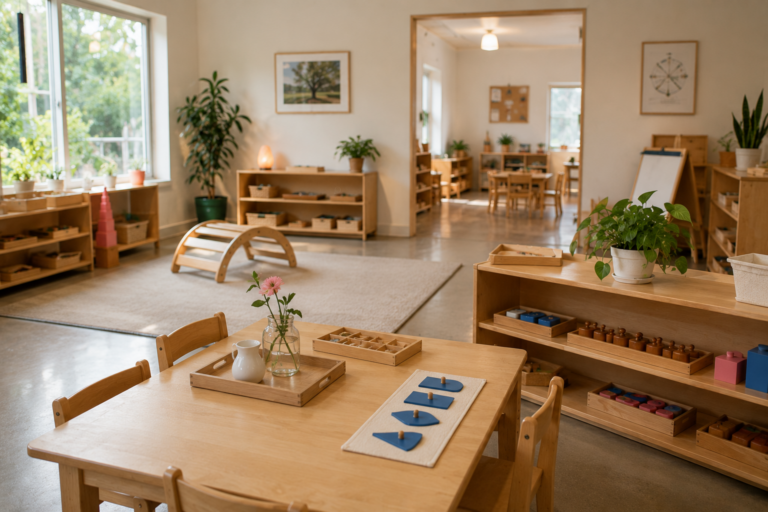
- Is the classroom calm, orderly, and beautiful? A genuine Montessori environment tends to feel peaceful and purposeful rather than chaotic.
- Are children able to move freely and choose their own activities? You should see children working independently and with genuine focus.
- Is the furniture child-sized? Are materials accessible at child height?
- Are there mixed-age groupings? Traditional Montessori classrooms group children across three-year age spans.
- Is there a clear distinction between work time and free play?
The Children
- Observe the children as much as you observe the environment. Are they engaged and purposeful?
- Do they appear confident, settled, and able to concentrate?
- How do children and teachers interact? Look for warmth, respect, and calm communication.
Curriculum and Philosophy
- How does the school approach discipline and limit-setting?
- What is the school’s policy on screen time?
- How does the school communicate with parents?
- How does the school handle the transition from Montessori into primary school, if relevant?
- Does the school offer parent education or information evenings? A good Montessori school typically welcomes parents as partners.
Practical Considerations
Beyond the philosophy, there are practical factors that matter for your family:
- Location and hours – can the school realistically fit into your family’s daily life?
- Fees – Montessori schools vary widely in cost. Ask whether sibling discounts, subsidies, or payment plans are available.
- Waiting lists – popular Montessori schools often have long waiting lists; enquire well in advance.
- Settling-in process – ask how the school supports new children during the transition period.
Trusting Your Instincts
Beyond the checklist, your instinct matters. When you visit a school, pay attention to how it feels. Do the staff seem warm and genuinely committed to the children? Does the environment feel inviting? Do you feel welcome to ask questions?
The right school for your child is one where you feel confident that your child will be seen, respected, and supported to flourish – and where the adults share your values for their education and wellbeing.
Montessori School Checklist
Choosing the right school for your child is one of the most important decisions you will make as a parent. When it comes to Montessori, that decision can feel especially complex because the word “Montessori” is not always used in the same way by every school.
Some schools follow Montessori principles closely, with trained teachers, mixed-age classrooms, carefully prepared environments, and long periods of independent work. Others may use some Montessori materials or ideas but follow a more general early learning approach.
This checklist is designed to help you ask useful questions, know what to observe when you visit, and feel more confident when comparing Montessori schools.
Please note: This checklist is for general information only. Every child, family, and school is different. Always visit the school, ask detailed questions, and consider what feels right for your child’s needs, personality, and wellbeing.
Why Choosing Carefully Matters
The quality and authenticity of Montessori schools can vary. A school may have beautiful Montessori materials, but materials alone do not make a strong Montessori programme. The quality of the teaching, the training of the adults, the classroom culture, and the way the environment is prepared all matter.
The reverse can also be true. Some excellent Montessori educators work with modest resources but create calm, respectful, deeply authentic Montessori environments. When visiting a school, look beyond the shelves and materials. Pay attention to the adults, the children, the rhythm of the room, and the overall feeling of the environment.
Quick Montessori School Visit Checklist
Use this checklist when visiting or comparing schools.
1. Teacher Training and Experience
- Do the lead teachers hold recognised Montessori qualifications?
- Are the qualifications specific to the age group they teach?
- How many teachers in the classroom are formally Montessori-trained?
- How many years of Montessori classroom experience does the lead teacher have?
- Does the school invest in ongoing teacher training and professional development?
- Can the school clearly explain how Montessori principles are applied day to day?
Questions to Ask
- What Montessori training has the lead teacher completed?
- Was the training in-person, online, or blended?
- How much supervised classroom practice was included?
- How do teachers continue learning and improving their practice?
What to Look For
- Teachers who speak calmly and respectfully to children.
- Adults who observe before intervening.
- Teachers who guide children rather than constantly direct them.
- A lead teacher who can explain the purpose behind the materials and routines.
2. School Accreditation and Montessori Affiliation
Ask whether the school is affiliated with, accredited by, or connected to a recognised Montessori organisation. Accreditation is not the only sign of a good school, but it can provide helpful independent reassurance.
Recognised Montessori organisations may include:
- Association Montessori Internationale (AMI)
- American Montessori Society (AMS)
- Montessori Australia
- Montessori Europe
- Other recognised Montessori organisations in your country or region
Questions to Ask
- Is the school accredited or affiliated with a Montessori organisation?
- When was the school last reviewed or assessed?
- What standards does the school follow?
- How does the school define its Montessori approach?
What to Keep in Mind
A school does not have to be perfect to be a good fit. Accreditation can be helpful, but the daily classroom experience, the teacher-child relationships, and the school culture are just as important.
3. The Classroom Environment
A Montessori classroom should usually feel calm, ordered, purposeful, and child-centred. It does not need to be silent, but it should feel respectful and settled rather than chaotic.
Checklist: The Environment
- Is the classroom calm, clean, and thoughtfully arranged?
- Are materials placed on low shelves within children’s reach?
- Does each material appear to have a clear place?
- Is the furniture child-sized?
- Are children able to move around the room safely and independently?
- Are natural materials used where possible?
- Is there enough space for floor work, table work, and movement?
- Does the room feel beautiful without being overstimulating?
Questions to Ask
- How is the classroom prepared each day?
- How often are materials changed or rotated?
- Are children free to choose their own work?
- How do teachers support children who are unsure what to choose?
4. The Daily Rhythm
Montessori schools often include a long, uninterrupted work cycle. This allows children time to choose work, concentrate, repeat activities, and complete tasks without being rushed.
Checklist: Daily Routine
- Is there a long uninterrupted work period?
- Do children have time to repeat activities?
- Is there a clear rhythm between indoor work, outdoor time, meals, rest, and group moments?
- Are transitions handled calmly?
- Is the day structured without feeling rushed?
Questions to Ask
- How long is the uninterrupted work cycle?
- How much outdoor time do children have?
- How are meals and snacks handled?
- How does the school support children during transitions?
5. Mixed-Age Groupings
Traditional Montessori classrooms often group children across a three-year age span. This allows younger children to observe older children, and older children to build confidence and leadership.
Checklist: Age Grouping
- Does the school use mixed-age classrooms?
- Are the age ranges clearly explained?
- Do younger and older children interact respectfully?
- Are older children encouraged to model skills without becoming “mini teachers”?
Questions to Ask
- What age ranges are grouped together?
- How does the teacher support children at different stages?
- How are new children introduced into the classroom community?
6. The Children
When visiting a school, observe the children as much as the classroom. Their behaviour can tell you a lot about the environment.
Checklist: What You May Notice
- Are children engaged in meaningful activity?
- Do they appear comfortable and settled?
- Can they choose work and return it independently?
- Do they show concentration, even for short periods?
- Do children treat materials and one another with care?
- Do they seem confident asking for help when needed?
What to Look For
You are not looking for perfection. Young children will still have difficult moments. Instead, look for whether the adults respond calmly, whether children are respected, and whether the room returns to a peaceful rhythm after disruptions.
7. Teacher-Child Interactions
The way adults speak to children is one of the most important signs of school culture. Montessori environments should be respectful, calm, and warm.
Checklist: Adult Interaction
- Do teachers speak respectfully to children?
- Do adults get down to the child’s level when appropriate?
- Are children given time to respond?
- Do teachers model behaviour rather than shame or embarrass?
- Are limits set calmly and clearly?
- Do adults appear patient and observant?
Questions to Ask
- How does the school handle conflict between children?
- How does the school approach discipline and limit-setting?
- What happens when a child refuses to participate?
- How are big emotions, tantrums, or separation difficulties handled?
8. Curriculum and Montessori Philosophy
A Montessori school should be able to explain not just what children do, but why they do it. The curriculum should support practical life, sensorial exploration, language, mathematics, culture, movement, and social development in age-appropriate ways.
Checklist: Curriculum
- Does the school offer practical life activities?
- Are sensorial materials used thoughtfully?
- Is language development supported through conversation, stories, sound games, and materials?
- Are mathematics materials introduced concretely before abstract work?
- Are nature, culture, geography, music, art, and movement included?
- Does the school avoid rushing children into academic work before they are ready?
Questions to Ask
- How do teachers know when a child is ready for a new lesson?
- How is progress observed and recorded?
- How does the school balance Montessori with local curriculum requirements?
- How does the school support children with different learning needs?
9. Discipline, Boundaries, and Emotional Support
Montessori is not a no-rules approach. A good Montessori school should have clear expectations, but those expectations should be handled with respect and consistency.
Checklist: Discipline and Emotional Support
- Are limits clear and calmly enforced?
- Are children treated with dignity during difficult moments?
- Does the school avoid shame-based discipline?
- Are children helped to repair relationships after conflict?
- Are emotional skills taught through modelling and guidance?
Questions to Ask
- Does the school use time-outs, rewards, or behaviour charts?
- How are hitting, biting, or conflict handled?
- How are children supported when they are upset?
- How does the school work with parents if behaviour concerns arise?
10. Screen Time, Outdoor Time, and Practical Life
Many Montessori families value hands-on, real-world experiences. It is helpful to ask how the school approaches screens, outdoor play, and practical daily tasks.
Checklist
- Is screen use limited, purposeful, or avoided for young children?
- Do children spend regular time outdoors?
- Are children involved in practical tasks such as food preparation, cleaning, gardening, or caring for the environment?
- Is movement built naturally into the day?
Questions to Ask
- What is the school’s screen time policy?
- How often do children go outside?
- Are children involved in caring for the classroom or garden?
- How does the school support physical movement and coordination?
11. Parent Communication and Community
A strong Montessori school usually sees parents as partners. Communication should be clear, respectful, and regular.
Checklist: Parent Partnership
- Does the school communicate regularly with parents?
- Are parent-teacher meetings offered?
- Does the school provide information about Montessori philosophy?
- Are parents invited to observe or attend information sessions?
- Does the school welcome questions?
Questions to Ask
- How will I know how my child is progressing?
- How often do teachers communicate with families?
- Do you offer parent education evenings or workshops?
- How do you handle parent concerns?
12. Practical Considerations
Even if a school is philosophically appealing, it also needs to work for your family’s real life.
Checklist: Practical Fit
- Is the location realistic for your family?
- Do the hours work with your daily routine?
- Are the fees manageable?
- Are subsidies, payment plans, or sibling discounts available?
- Is there a waiting list?
- What is the settling-in process?
- What is the policy for illness, holidays, absences, and late pickup?
Questions to Ask
- What are the total costs, including extras?
- How long is the waiting list?
- How do you support new children during transition?
- Can we visit more than once before deciding?
Red Flags to Notice
No school is perfect, but some signs may be worth paying attention to.
- The school cannot clearly explain its Montessori approach.
- No teachers have recognised Montessori training.
- The room looks beautiful, but children are mostly being directed by adults.
- Children have little freedom to choose work.
- The classroom feels chaotic, rushed, or overly controlled.
- Adults speak harshly, shame children, or use fear-based discipline.
- The school discourages reasonable parent questions.
- There is heavy reliance on screens or passive entertainment for young children.
- Materials are used mainly as toys without clear purpose or guidance.
Green Flags to Look For
- Children appear engaged, purposeful, and comfortable.
- Teachers are calm, respectful, and observant.
- The classroom is ordered but not rigid.
- Children can move, choose, repeat, and return work independently.
- The school can explain how Montessori principles guide daily life.
- Parents are welcomed as partners.
- The school values independence, kindness, concentration, and respect.
Trusting Your Instincts
Beyond the checklist, your instinct matters. When you visit a school, pay attention to how it feels. Do the staff seem warm and genuinely committed to the children? Does the environment feel inviting? Do you feel welcome to ask questions?
The right school for your child is one where you feel confident that your child will be seen, respected, and supported. Montessori is not about a perfect room or expensive materials. It is about the quality of the environment, the skill of the adults, and the respect shown to the child.
Final Checklist Before You Decide
- I have visited the school in person.
- I have observed the classroom while children were present, if possible.
- I understand the teacher training and experience.
- I understand the school’s approach to discipline and emotional support.
- I understand the daily routine and work cycle.
- I know how the school communicates with parents.
- The practical details work for my family.
- The environment feels calm, respectful, and suitable for my child.
- I feel comfortable asking questions.
- I can imagine my child feeling safe, respected, and supported here.
-
Montessori School Selection Checklist
Everything to look for, ask, and consider when choosing a Montessori School.
-
FREE Montessori at Home Starter Guide 0-3 Years
FREE Montessori at home starter guide for parents with children 0-3 years old.
This page is for general informational purposes only; please consult a qualified professional for advice specific to your child’s individual needs.