
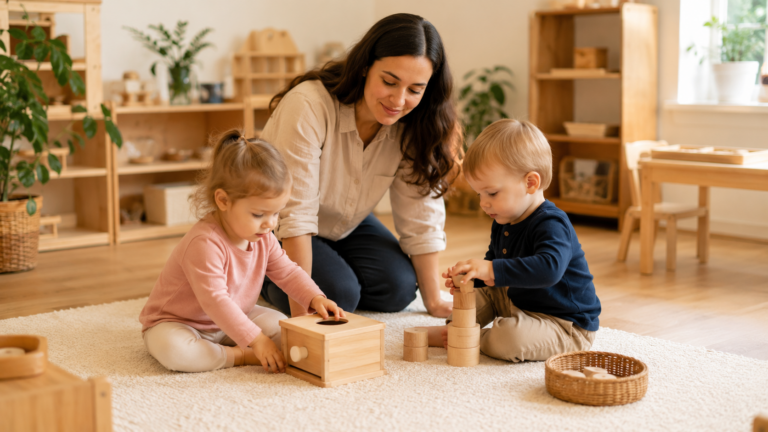
Q: Every time my child sees a toddler at the park or at home, he starts pinching or hitting. I say “no,” but should I be giving a time out? I’m not sure if that goes too far. How do I stop this behaviour?
A: The most helpful first step is to look for the why behind the hitting. Is there jealousy involved — does the other child have something your son wants? Is he trying to enter a space, or feeling that his space has been entered? Is the hitting related to language frustration — is he struggling to express what he needs or wants?
Understanding the cause helps you respond more effectively both in the moment and over time. If language frustration seems to be a factor, gently encouraging him to use words and modelling how to interact kindly with other children can be supportive.
In the Moment
When hitting occurs at the park, calmly acknowledge it: tell him that hitting hurts and is not something we do, then move him to a different area for a short time. This is not so much a traditional “time out” as it is removing him from the situation to give both children space. Keep your tone calm and matter-of-fact rather than reactive — a big response can sometimes reinforce the behaviour unintentionally.
Natural Consequences
The natural consequence of hitting is that he is no longer able to play alongside the other child at that moment. After a few minutes, if he seems ready, he can try again with gentle guidance nearby. Model — and narrate — gentle touch where possible: “Let’s show her how we touch gently.”
Over Time
Consistency is important. If the message and response are the same each time, children generally begin to understand the expectation. It can also help to ensure his needs for movement, connection, and engagement are well met throughout the day, as tired or frustrated children are more likely to act out physically.
Hitting at this age, while challenging, is a common phase. It is generally not a sign of aggression but of a child who has not yet developed the language or self-regulation skills to manage difficult feelings. With patience and gentle, consistent guidance, most toddlers move through this stage.
This post is intended for general informational purposes only; please consult a qualified professional for advice specific to your child’s individual needs.

hello,
1)child attacking- every child needs attention, touch therapy, something to keep them occupy, focus on these like engage in paly or toy, giving him his space in environemnt.any child likes cuddling, fondling, hugging while doing so do it gently, some adult dont do it this makes them aggressive, sing them lullaby or soft love stories before bed it helps.
2) child defending- its not possible for any adult namely parent or teacher to be available, so teach the child to narrate whole day incident. teach him to say no or physically move away when some one is trying to grab his hand. ask the child to tell teacher every school event.
3) at home teach them difference between warm shake hand, warm hug and ask child’s permission like ‘shall i shake hand with you i wont hurt you’,’shall i hold your hand’ etc
in montessori activities we have something called invitation or seeking child’s permission before doing any activity or before presentation.
Hi,My son is 38 months old and he is still not talking all the words but he understands all the conversations we o with him.But he will not reply back in words but try to tell in signs and few words sometimes.whenever he tries to show signs i will always keep on telling him the words and encourage him to speak. please kindly suggest me some other methods to improve his talking skills.
1) speech activity- you can teach sounds or phonetics slowly like vowels as its used every word. a, e, i , o, u loudly, clearly, showing every movement of your lip. like when u say vowel ‘o’ make your mouth round and say oooooooo and give simple words like ‘go’.
2) noise box- put some beeds, things which make noise in container, close it tightly and ask him to shake. you should have different material which make different noise, soft sand, rough sand lttile stones, beeds, buttons, all harmless things. This helps in hearing and speech related things
3) explain words with picture – select appropriate picture eg want to talk about food, have some ve g, fruit picture use them.
My Granddaughter is 6 and a very loved child. At school she is frequently spotted smacking other children and 1 or 2 of the mothers, quite naturally, have complained. My Daughter has been told by the teachers and believe me we have tried every punishment we can, other than smacking. She has had favourite things removed, sent to her room, no treats, and a good talking to but it still keeps happening. At other times she is a talented lovely little girl who loves us all and is upset if we cut our finger or bang our arm so is sensitive too. She has a little brother who is 20 months younger and he is just the opposite, we try to treat them both exactly the same and do not show favouritism at any time but she is so jealous of anything that he has but she also has lovely things. We love her so and do not want her to become a child that no one wants to play with. What do we do???
If you notice that your child is hitting somebody else, don’t let him/her get away with it. Tell your child firm, but gentle, that hitting is wrong.
my son Connor is 3 1/2 and he hits all the time! I just don’t know what to do. if a child has a toy he wants he hits,if a child is on the swing and he wants it he will cry,even if a child sits next to him he does not want anyone near him he will hit. I put him in timeout when he hits but this just does not seem to be working…today he got sent home early from preschool because he just could not keep his hands to himself. he just seems so angry all the time…he can be so sweet and laughing and playing with his 10 mo old sister and the next second he is hitting her or throwing something…when building blocks and they fall over he gets so angry just throws them all. how do I teach him to control his temper?
My son was in a situation at school recently where he was firstly pushed which resulted to swelling above his nose, then a few days later scratched under the eye which also lead to swelling and bruising. I have tried my very best to try and not take his anger or frustration out on anyone but to notify the teacher straight away
Hi!
Unfortunately hitting in playgrounds may happen and we will not always be there to prevent it or correct it. Well, it is also good for you to empower your child or learn to defend herself with socially acceptable means- which is not hitting back which may happen- but using other ways of communication such as teaching them to say “stop†to the other child or just make a gesture meaning “stop†or teaching them to simply move away from the child who hit. It will take a lot of practice and patience from you to teach this to your child but eventually it will progress to them talking to the other child if there are any differences encountered.
I hope this helps.
Regards,
Daily Montessori
Hey, a nice question and useful suggestions. thanks for that. But i wanna reverse the question and ask what to do when a child hit my baby (14months now)? Because i don’t want to interrupt her play too much with other kids in terms of she should experience it herself. But then I am afraid that my baby will be bullied later on her life without learning how to defend herself!!
Do you have any suggestions how to act in such situation?/ especially if there is no parents around to correct that kid, what to do? what should I say to my kid about how to defend herself or should I say anything?
Your answer will be much appreciated as I am little bit concerned about most of the kids behaviour at the playgrounds etc.
Thanks.