
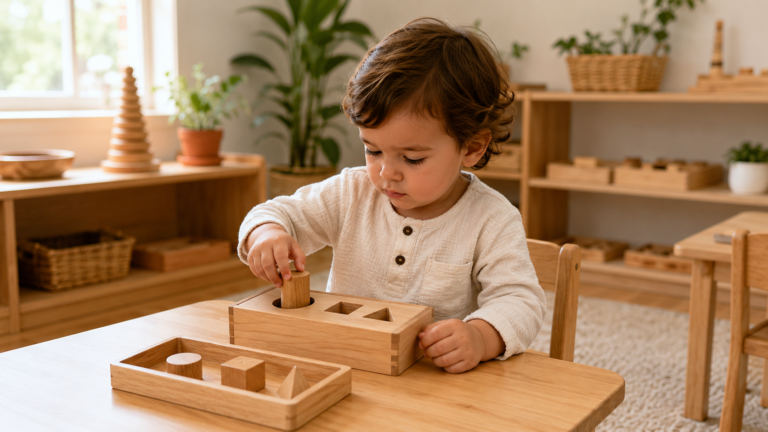
One of the most striking things you may observe in a child who has found a genuinely absorbing activity is the quality of their attention. Their gaze becomes focused, their body settles, and they work with a seriousness and persistence that can be surprising in a very young child. Maria Montessori called this state the normalised child — and she considered the capacity for deep, voluntary concentration one of the most important gifts of a child’s development.
What Deep Focus Looks Like in Young Children
Deep concentration in toddlers looks different from adult focus — but it is real and significant. You may notice your child:
- Repeating the same action many times without apparent frustration — pouring water from cup to cup, stacking and restacking blocks
- Becoming genuinely absorbed in a self-chosen activity for an extended period
- Showing displeasure when interrupted mid-task
- Returning to the same activity repeatedly over days or weeks
These are signs of the work cycle in action — the natural rhythm of choosing, engaging, and completing that Montessori environments are designed to support.
Why Concentration Matters
The ability to sustain voluntary attention is foundational to almost every kind of learning. Research in developmental psychology consistently links the development of executive function — which includes attention, self-regulation, and working memory — to positive outcomes across academic and social domains. The good news is that concentration is not a fixed trait: it develops through practice, and the early years offer a particularly important window.
What Supports Deep Focus
An Uncluttered Environment
Too many choices and too much visual stimulation can fragment attention rather than sustain it. A Montessori shelf with a small number of carefully chosen activities, clearly displayed, tends to invite deeper engagement than a room full of toys.
Materials Matched to the Child’s Developmental Level
Activities that are slightly challenging — requiring effort but not beyond the child’s current ability — tend to produce the most sustained engagement. Activities that are too easy are quickly abandoned; those that are too difficult produce frustration rather than focus.
Freedom to Choose
Children engage far more deeply with self-chosen activities than with directed ones. The act of choosing is itself part of developing executive function — it requires intention and commitment to a decision.
Uninterrupted Time
Deep concentration requires time. Protecting even a short block of uninterrupted work time — and resisting the impulse to redirect, help, or comment — can make a meaningful difference to a child’s developing capacity for focus.
What Can Undermine Concentration
- Frequent adult intervention — offering help, redirecting, or asking questions mid-activity
- Background noise and screens
- Transitions before the work cycle is complete
- Activities that are too passive or insufficiently challenging
- Tiredness and hunger — always worth checking when concentration seems difficult
The Adult’s Role
Montessori described the adult’s role during a child’s deep work as one of watching and waiting. This doesn’t mean ignoring the child — it means trusting the process and resisting the impulse to intervene unnecessarily. A child who is working with focus is doing exactly what they should be doing. The most supportive thing an adult can often offer is the gift of not interrupting.
This post is for general informational purposes only; please consult a qualified professional for advice specific to your child’s needs.