
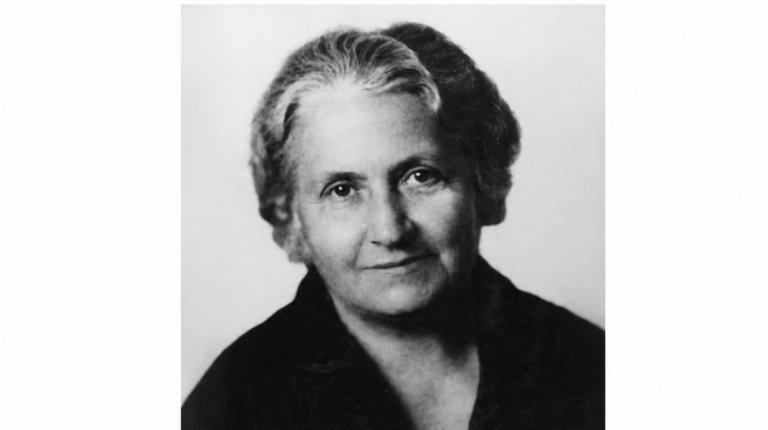
Montessori theory is an approach to child development and education developed by Dr. Maria Montessori, an Italian physician and educator. Montessori philosophy of education is based on the understanding that children learn most effectively through independence, hands-on experiences, and a carefully prepared environment.
The six core principles of Montessori theory are:
- Independence
- Observation
- Following the Child
- Correcting the Child
- The Prepared Environment
- The Absorbent Mind
These principles are not simply educational ideas – they directly support how children naturally grow and learn. When applied consistently, they can help children build independence and confidence, develop focus and concentration, learn through real experience, and feel respected and capable in their environment. They are especially powerful in the early years (0–3), when brain development is at its most rapid.
Who Was Maria Montessori?
Dr. Maria Montessori was one of the first female physicians in Italy and a pioneer in child development. Through her work with children in the early 1900s, she observed that children learn differently from adults – that they are naturally curious, capable, and driven to explore their world.
Rather than imposing traditional teaching methods, Montessori developed an educational approach based on observation, respect, and independence. Her key insight was simple but profound: children are not empty vessels to be filled – they are active learners who develop through experience. This understanding remains the foundation of Montessori theory today.
The Six Core Principles of Montessori Theory
1. Independence
“Never help a child with a task at which he feels he can succeed.” – Maria Montessori
Independence is a central goal of Montessori education at every level. Children are given opportunities to move, dress themselves, choose their activities, and participate meaningfully in daily tasks. When children are able to do things for themselves, there is a natural increase in self-belief, confidence, and esteem – qualities they may carry with them throughout their lives.
2. Observation
Observation – genuinely watching and attending to the child – is both the method through which Maria Montessori developed her theories and a daily tool for parents and educators. By observing without preconceived ideas, Montessori learned what children needed, what interested them, and what materials would best support their development.
For parents, observation is a powerful and accessible practice. If a child begins banging on objects, this may indicate a need for gross motor activity – offer a drum. If a toddler repeatedly pushes things across the floor, they may be seeking walking support – offer a sturdy push toy or wagon. Observation turns behaviour into useful information rather than frustration.
3. Following the Child
“Follow the child – they will show you what they need to do, what they need to develop in themselves and what area they need to be challenged in.” – Maria Montessori
From what you observe, follow the child’s lead. If they want to climb, provide a safe opportunity to do so. If they are drawn to water play, create a safe space for it. Following the child also means being non-directive – not telling children what to do at every moment, but rather presenting choices and then stepping back to observe what they do with that freedom. Knowing when to intervene – and when to wait – is a skill that develops with time and practice.
4. Correcting the Child
Children make mistakes. They may spill water, drop food, mispronounce a word, or misjudge how much something weighs. Montessori’s approach to these moments is calm and matter-of-fact rather than critical.
When something spills, a gentle response might be: “Oh, you’ve spilled the water – why don’t we get a cloth and wipe it up?” This turns the mistake into a practical activity rather than a source of shame. Many Montessori materials are also self-correcting: a child learning to pour from a glass will quickly discover that tipping it too early results in a spill – the material itself provides the feedback without adult intervention.
Correcting through observation and gentle modelling – rather than direct criticism – helps children remain willing to try, experiment, and learn from experience without fear of failure.
5. The Prepared Environment
“The teacher’s first duty is to watch over the environment, and this takes precedence over all the rest.” – Maria Montessori
The prepared environment is the physical and social space in which the child learns. In Montessori, rooms are child-sized and designed to invite independent activity: low shelves hold carefully chosen materials, furniture is appropriately scaled, and everything has a clear and consistent place.
The environment must be safe, accessible, and beautiful – one that invites the child to engage and work. Montessori used the word “work” deliberately: the child’s activity – what others might call play – is serious, purposeful, and self-constructing. The adult’s role is to prepare and maintain the environment in which this work can flourish.
6. The Absorbent Mind
Montessori observed something remarkable: young children learn language, cultural norms, and complex social patterns without any formal instruction. They simply absorb the world around them – effortlessly and unconsciously. She called this the
absorbent mind – the unique capacity of children under approximately six years of age to take in everything from their environment as a direct part of themselves.
Because children absorb everything – the beautiful and the difficult, the calm and the chaotic – the quality of the environment and the tone of those around them matters enormously. What children live with, they absorb. What they absorb becomes part of who they are.
Montessori Philosophy vs Traditional Education
Montessori education differs from traditional schooling in several important ways:
- Child-led learning rather than teacher-directed instruction
- Hands-on, concrete activities rather than worksheets and passive learning
- Mixed-age classrooms (typically spanning three years) rather than same-age groupings
- Intrinsic motivation rather than external rewards and grades
- Uninterrupted work periods rather than frequent transitions between subjects
- Focus on the whole child – independence, social development, and emotional wellbeing alongside academic skills
The Montessori approach is not the only valid approach to education, and it is not the right fit for every child or family. However, for many children – particularly in the early years – its emphasis on respect, independence, and meaningful experience can provide a deeply effective and joyful foundation for lifelong learning.
This page is for general informational purposes only; please consult a qualified professional for advice specific to your child’s individual needs.