
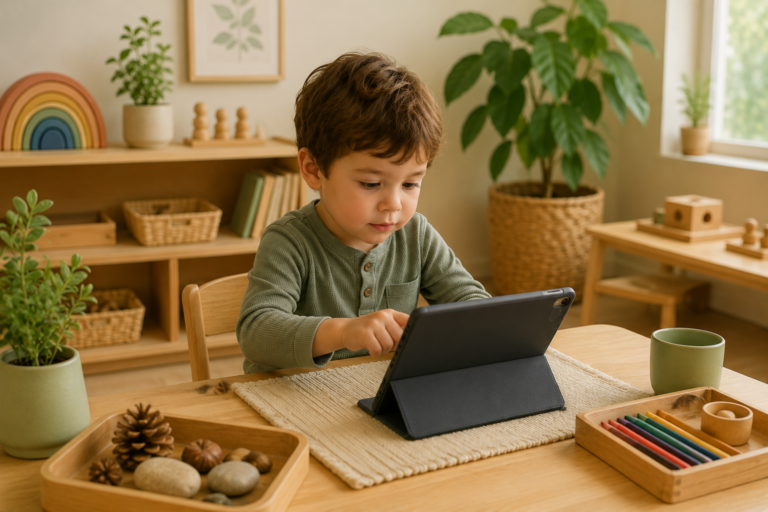
Screen time is one of the most frequently discussed topics in contemporary parenting. The Montessori approach, developed long before the digital age, does not provide a specific formula for screen use. However, its core principles offer a clear and coherent framework for thinking thoughtfully about when, how, and why screens enter a young child’s life.
The Montessori Perspective
Montessori philosophy places enormous value on direct, hands-on experience of the real world. Young children — particularly in the first six years — are in the period of the absorbent mind, taking in their environment through all their senses, through movement, and through real interaction with real objects and people. The concern about screens is not primarily about content, but about what screen time can replace: the rich, multisensory, interactive experiences through which young children learn most deeply.
What the Research Suggests
Current research in child development and paediatrics offers some broadly consistent findings:
- For children under 18–24 months, passive screen exposure (other than live video calls) appears to offer little developmental benefit and may displace other valuable activities
- The quality and context of screen use matters significantly — co-viewing with an engaged adult produces better outcomes than solo passive viewing
- Screens used close to bedtime can interfere with sleep onset in young children
- Excessive passive screen time is associated with reduced physical activity and face-to-face social interaction
This research area continues to evolve. The consensus among most paediatric organisations is consistent: the younger the child, the more cautious the approach to screen use.
Practical Guidelines by Age
Under 18–24 Months
Most paediatric guidance — including that of the World Health Organization — suggests avoiding passive screen use for children under 18–24 months, with the exception of video calling (which involves real interaction with a real person). This is a broad guideline that individual families will navigate differently.
2 to 5 Years
When screen use is introduced, quality and context matter. Useful considerations:
- Watch together — co-viewing and discussing what you see is far more valuable than solo viewing
- Choose thoughtfully — slow-paced content tends to be more appropriate than fast-paced entertainment
- Keep it bounded — clear, consistent limits around when screens are available (not at mealtimes, not before bed) help children understand that screens are one activity among many
- Transition thoughtfully — give advance warning before ending screen time to ease the transition
A Useful Framing Question
What is this screen time replacing? If it’s replacing outdoor play, hands-on creative activity, or social interaction, it’s worth considering alternatives. If it’s a brief, bounded use that allows a parent to take an important call or prepare dinner, that is a different calculation entirely.
Creating a Screen-Conscious Home
- Keep screens out of bedrooms and off during mealtimes as a default
- Be mindful of adult screen use in front of young children — children absorb the behaviours they observe
- Ensure the home offers a rich environment of alternatives — books, art materials, outdoor access, natural objects
Avoiding Extremes
The Montessori approach does not call for the complete exclusion of technology from a child’s life — that would be both impractical and counterproductive in preparing children for the world they will inhabit. The goal is a thoughtful, proportionate relationship with technology: one that preserves the primacy of real-world, hands-on experience in the early years.
This post is for general informational purposes only; please consult a qualified professional for advice specific to your child’s needs.