Movement is not simply a physical activity in early childhood — it is deeply connected to learning, brain development, and the child’s growing understanding of themselves and the world. Maria Montessori placed great emphasis on the role of movement, observing that young children have a powerful, innate drive to move, and that this drive has profound developmental significance.
Movement and the Developing Brain
Research consistently supports the idea that movement and cognition are closely linked in early childhood. Physical activity supports the development of neural pathways, contributes to language and mathematical thinking, and plays an important role in emotional regulation and self-control. The body and mind are deeply interconnected — learning that happens through movement tends to be deeper and more durable than passive reception of information.
The Sensitive Period for Movement (Birth to Approximately 4 Years)
Children in this sensitive period are driven to develop and refine increasingly precise, coordinated, and intentional physical skills. You can observe this in:
- Babies working intently to reach, grasp, and manipulate objects
- Toddlers practising walking, climbing, and balancing — often repetitively — until the movement is mastered
- Young children’s fascination with pouring, threading, cutting, and other fine motor activities
- The deep satisfaction children take in using tools and real objects with skill
Gross Motor Milestones: 0–3 Years
Birth to 6 Months
- Head control during tummy time (from birth, supervised)
- Rolling front to back and back to front (typically 3–5 months)
- Pushing up onto forearms during tummy time
6–12 Months
- Sitting independently (typically around 6–8 months)
- Crawling (various styles — all are valid)
- Pulling to stand and cruising along furniture
- First independent steps (typically between 9–14 months, with wide variation)
12–24 Months
- Walking increasingly confidently — then running
- Climbing stairs with support, then independently
- Squatting to pick up objects
- Beginning to kick and throw balls
24–36 Months
- Running with improved coordination and speed
- Jumping with both feet
- Climbing play structures with growing confidence
- Riding a balance bike or similar
- Increasing strength and physical endurance
Supporting Gross Motor Development at Home
A Montessori-inspired approach to movement means creating an environment that allows and encourages purposeful physical activity:
- Floor time from infancy — firm mat on the floor, not confined to bouncer or rocker for extended periods
- Safe outdoor play — daily access to outdoor space for large-movement experience
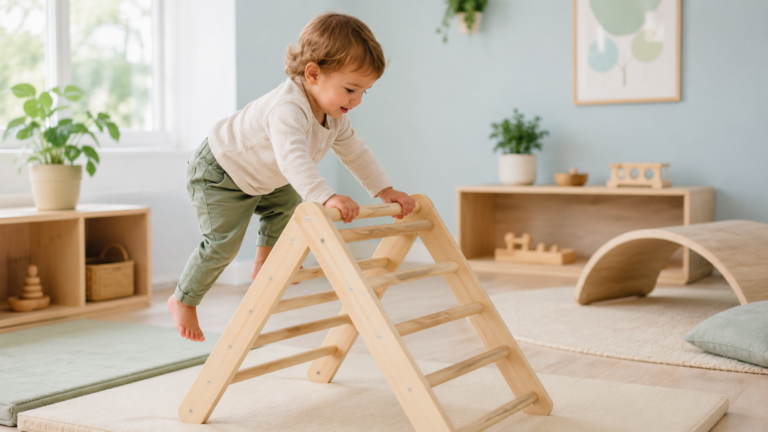
- Climbing opportunities — a Pikler triangle, low climbing frame, or play structure appropriate to age and ability
- Unstructured movement time — free play that allows children to move at their own pace and challenge themselves
- Real tasks that involve movement — carrying, pushing, pulling, and physical participation in household activities
- Minimise time in restrictive equipment — bouncers, jumpers, and walkers used for extended periods can limit the free movement that supports development
When to Seek Guidance
Children develop at different rates, and gross motor milestones have a wide range of typical timing. If you have any concerns about your child’s movement development, please discuss them with your health visitor or paediatrician. Early support, when needed, is most effective when started promptly.
This post is for general informational purposes only; please consult a qualified professional for advice specific to your child’s needs.