Montessori Outdoor Exploration: Nature Activities for Toddlers
For Maria Montessori, the natural world was not a backdrop to education — it was one of its richest classrooms. She advocated strongly for children’s regular contact with nature, believing that the living world offered experiences of complexity, beauty, and wonder that no indoor environment could fully replicate.
For toddlers and young children, outdoor exploration is developmentally essential. The natural environment provides sensory richness, physical challenge, open-ended discovery, and a sense of connection to something larger than the domestic world.
Why Outdoor Exploration Matters
- Sensory development — nature offers an extraordinary range of textures, sounds, smells, and visual stimuli
- Gross motor development — uneven terrain, hills, logs, and natural obstacles support balance and physical confidence in ways flat indoor surfaces cannot
- Cognitive development — the natural world invites observation, questioning, prediction, and discovery
- Emotional regulation — time in natural environments is consistently associated with reduced stress and improved mood in children
- Environmental connection — children who spend time in nature tend to develop genuine care and curiosity about the natural world
Nature Observation Activities
- Collect seasonal natural objects — leaves, pinecones, seed pods, pebbles, shells — for a nature tray at home
- Observe changes over time: the same tree across seasons, a caterpillar to butterfly, a planted seed to a sprout
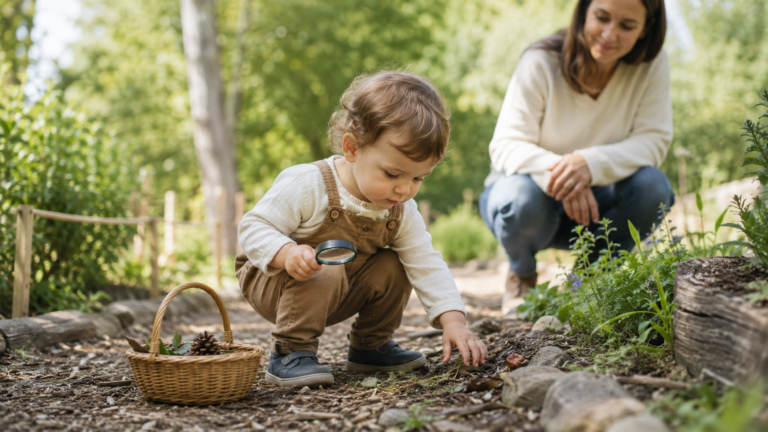
- Use a simple magnifying glass to explore bark, soil, flowers, and insects up close
Gardening
- Even a single pot on a windowsill or balcony allows for seed-to-harvest gardening
- Children can be involved in digging, planting, watering, weeding, and harvesting
- Grow edible plants — radishes, herbs, and cherry tomatoes are fast and satisfying for young children
Sensory Outdoor Play
- A mud kitchen — old pots, utensils, and access to soil and water — provides hours of rich, open-ended sensory play
- Water play outdoors — a shallow tub, some containers, and outdoor clothing that can get wet
- Sand play — rich tactile and creative experience
Movement and Physical Exploration
- Balancing on logs or stepping stones
- Walking on varied terrain — grass, gravel, soil, sand
- Rolling down hills, jumping in puddles, running freely
- Climbing (age and ability appropriate, always supervised)
Nature Art and Creativity
- Leaf rubbings — place a leaf under paper and rub with a crayon
- Printing with natural objects — leaves, bark, flowers
- Mandalas made from natural objects arranged on the ground
- Simple nature journals — drawing and observing together
The Adult’s Role Outdoors
Outdoors, as indoors, the Montessori adult’s role is primarily that of observer and enabler — creating conditions for exploration, staying close enough for safety, and resisting the impulse to direct, instruct, or over-narrate. A child given space and time to make their own discoveries in the natural world is building a relationship with nature that no adult-directed lesson can provide.
This post is for general informational purposes only; please consult a qualified professional for advice specific to your child’s needs.