
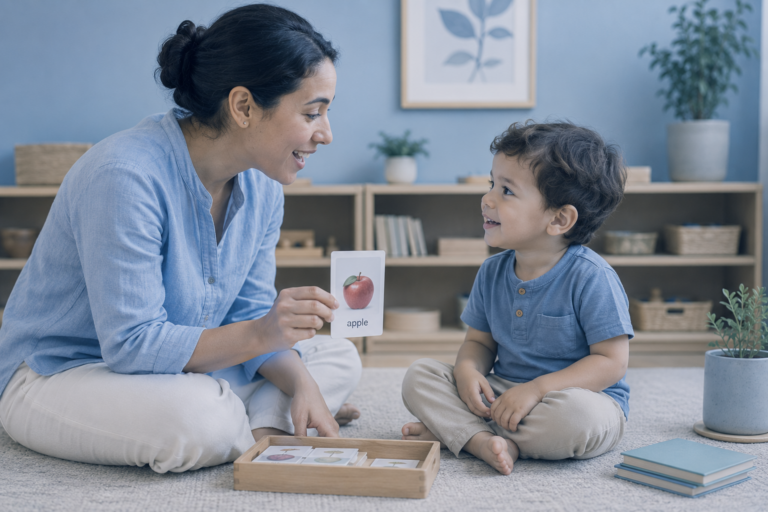
Toddlers and Language
As your child grows into the toddler stage, and you have already established some communication rhythms together, it is generally time to move away from the high-pitched motherese tone used with very young babies. Continuing to speak this way for too long may not support the kind of language development toddlers need at this stage.
Toddlers benefit from being spoken to like real people — in complete sentences, with natural intonation, and with genuine respect. Children at this age are often more perceptive than we give them credit for, and they absorb a great deal from what they hear around them. This is a particularly rich sensitive period for language, which makes the quality of the language they are immersed in especially important.
Speak in Full Sentences
Rather than keeping things to one or two words, try using complete sentences as you would with another adult. Ask open questions that invite a response, not just yes-or-no answers. It is through this kind of real, human interaction — not from passive TV watching — that toddlers begin to build their vocabulary and communication skills.
Language Expansion
Try extending and enriching the language you use. Rather than saying simply “ball,” try “big round orange basketball.” This naturally builds vocabulary and introduces children to more precise, descriptive language. Using accurate, real terms — even for everyday objects — can be more helpful than generic labels. For example, naming the specific type of vehicle (“red delivery van”) rather than just saying “car” gives children a richer vocabulary over time.
Language and Emotional Development
Learning to communicate effectively may also help reduce frustration in toddlers. When children are able to express their needs and feelings through words, they have a constructive outlet for what can otherwise come out in other ways. Support this by naming emotions for them during everyday moments — “I can see you’re feeling frustrated” — which helps them develop their emotional vocabulary alongside their spoken language.
This post is intended for general informational purposes only; please consult a qualified professional for advice specific to your child’s individual needs.


Thank you for your wonderful site! especially Thankful for the last sentence of this article, that just repeating it correctly is ideal at this stage. So glad I am not expected to give a grammar lesson all the time as my daughter is still quite young.
My four yr old son have been hitting kids at his school for no apparent reason. He has learning disability.
i thank you for this good work done in my child’s life really need more not for mine alone but the community as a whole.
thank you God bless.
Thank you for posting this topic to your site now i know that i’m on the right path of teaching my daughter.. it is so informative and helpful.. i will absolutely share this to my friends & relatives..
I had it way too easy with my first–he has/had a great vocabulary. Now with my second I am finding I need a little more direction. This article is great-
Thanks so much! This confirms what I intuitively want to do with my children, but often find myself copying the “baby talk†that we hear most grown-ups doing. Thanks for the great information, reminder and encouragement!
I am really finding all this not only informative but also helpful in brining up my child, my only son.
thanks