
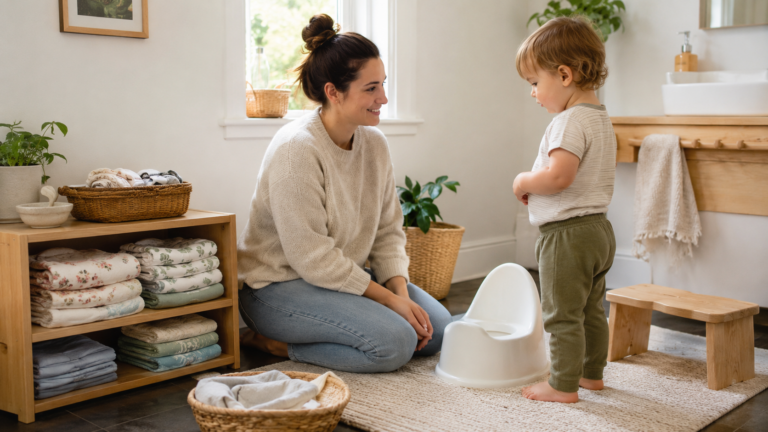
There is an important distinction in the Montessori approach between toilet training and toilet learning. The difference lies primarily in who leads the process — and the attitude of the adult involved.
Toilet training tends to be adult-directed, often based on a timeline that suits the adult rather than the child’s developmental readiness. It may involve pressure, reward systems, or expectations set before a child is naturally ready — which can sometimes create stress for the child and the family.
Toilet learning, by contrast, follows the child’s own readiness. It involves the child in the process from the beginning, supports their growing sense of independence, and treats toileting as a practical life skill to be learned over time — not a behaviour to be trained overnight.
Readiness Signs
Toilet learning generally begins when a child shows signs of readiness, which may include showing interest in the bathroom or in what others are doing there, staying dry for longer stretches, communicating before or after soiling, or pulling at their nappy. These signs typically emerge somewhere between 18 months and 3 years of age, though every child is different.
Language and Attitude Matter
The language and emotional tone used around toileting can have a meaningful impact. Positive, matter-of-fact language — without making a big deal of either successes or accidents — helps children feel supported rather than pressured. In the Montessori approach, there are no “accidents” — only opportunities for learning.
Practical Steps to Support Toilet Learning at Home
- Introduce a small potty or step-up toilet insert early, so your child becomes familiar and comfortable with it before they begin using it.
- Use clothing your child can manage independently — pull-up underwear or trousers with elastic waists make it easier for them to respond to their own body signals.
- Allow your child to observe — children learn a great deal by watching trusted adults.
- Keep the bathroom accessible and non-intimidating.
- Avoid shaming or expressing frustration when accidents occur; this is a skill that takes time to develop reliably.
Adult Readiness
It is also worth considering your own readiness to commit to the process. Toilet learning requires patience, consistency, and the ability to stay calm when things do not go to plan. Starting when both you and your child are ready makes the journey much smoother for everyone.
This post is intended for general informational purposes only; please consult a qualified professional for advice specific to your child’s individual needs.


Hello, I watch a 3 year old boy. The only time he has a bowel movement is during his nap time. He wears a diaper to bed at this time only. During the day he wears underwear. He does go pee before and after nap time, only because I ask him to go. He still cannot take off or put on his clothes. How can I correct this?
Hi. My baby is `16m.o. We introduced the potty a while ago and at first she used it to urinate and had BM on it a few times. It seemed random, but she seemed to enjoy it. Then she stopped being interested in it. We always change her in the same spot in the bathroom and now she points to potty and knows that it is related to diaper change, but she does not want to sit on it any more. She is also inconsistent in using a sign for change of diaper and is more tolerant of staying wet than before. We use cloth diapers 95% of the time and usually change her right away, so she is not used to having a wet or dirty diaper on more than a few minutes. She also wakes up a few times a night with a wet diaper. That has not stopped since she was a baby.
How do I teach her to remove her diaper if it’s prefold with a snappy? Also, changing her standing up is not really possible with cloth diapers. We tried. Not sure how to proceed with her and what to do with the routine.
Would appreciate any suggestions.
Thanks.
Hello! My daughter is 14m old, she’s has constipation problems that have transformed in actual resistance toward bowel movements. I have to assist here when she shows signs of a bm to squat on the potty otherwise she Will hold it in. Obvioisly she objects to that..even though the constipation has been solved.
Does anybody have some suggestion on How to make the potty more likable so that i don’t have to force her?
I have a three year old boy. If you don’t ask him to sit on a pot, he will urinate on his pants but if you ask him he will sit and urinate in the pot. the biggest problem is that he always pee on his pants. Please help what should I do.
Oh and I forgot to add that he doesn’t show interest in putting on or taking off his undies or pants. He’s usually too distracted with playing or other things. He’s shown interest in hats and socks but maybe he’s just used to me dressing him? Also sorry if this blog isn’t active! I look forward to a response anyway!!
Hello!
We have recently started implementing the Montessori method in our sons life and also started potty learning. He’s almost 16 months old. I read that 12-18 months is the sensitive period for this… He’s not showing all the signs you have listed here though. He’s been in cloth diapers since he was 6 months old. But I didn’t change him whenever he wet one so he’s used to being wet. A few months ago we got him a potty and started using it with him when he’d have a bm. A few days ago we started really potty learning and I’ve been putting him in a prefold around the house and changing him as soon as it’s wet. He’s also been wearing underwear part of the time too. I’ve been successful in getting him to pee when he first wakes up and occasionally at other times. I know it’s only been a few days but I’m wondering if he’s ready? He doesn’t know the words for potty and the only sign he gives before peeing is stopping and staring into space. We can never get him to the potty soon enough though, and he doesn’t even seem to notice the wet undies. Is it ok to pick him up and place him on the potty? I ask him and talk him through it every time and sometimes we read stories while he sits but other times he refuses and then he’ll walk away and pee somewhere else. Should I keep it up and just keep taking him at regular times?
Hi. My daughter became interested in toileting at around 20 months, and we officially started having her go on the potty at around 26 months, when I felt she was truly ready (she exhibited most of the appropriate signs). She began extremely well, and for the first few days was excellent. No accidents, very straightforward communication, and she learned how to hold it slightly to be able to make it across the apartment to the bathroom in time. In short, it seemed she was done. We put her in underwear from the beginning, as a side note. That seemed to encourage it. Then she experienced a traumatic event where she fell off the toilet after leaning too far over and became terrified of the toilet. We got her a smaller potty and things progressed from there albeit slowly. She began to have accidents now, and would often forget or just never bother to tell us that she had to go. There have been times in the past where she would have a few “good” days in a row, where she would have 1 accident, or none at all, and only pee. Poo she almost always did in the toilet. Pee she just couldn’t hold. She’s almost 3 now and she is still having trouble remembering to go. She doesn’t need rewards (and we haven’t used them, as we are not advocates of such a method), she simply forgets to go when she is distracted by her environment.
Could this possibly be a medical thing? Could she have some kind of infection? I didn’t think that could be because she hasn’t complained that anything bothers her or hurts her (and she is extremely verbal and does tell me when anything else is wrong). I’m simply at a loss. Are there any ways in which I can encourage her more? Am I doing what needs to be done? Is this a phase she just hasn’t ended yet? Some advice/guidance would be greatly appreciated.
Thanks
Hello, thank you for this article. I don’t know what can I do if the child is 2 years and he is in this transitio. Now, but he is afraid to go to sit down into the toilet. He doesn’t want.
What can I do?
I appreciate your help,
Sincerely,
Sonia
[quote name=”Ivette”]
he had a constipation problem, he use to not go for 3 days, cause he knew that meant pain. I tried to sit him in the toilet or potty and he just does not want to do it…[/quote]
Ivette, one of the children in my class had this problem just before she turned 3. She was constantly between constipation (from holding it) and diarrhea (from being given a laxative). After several months of struggling with this, I encouraged the parents to choose one of two extremes: either give up potty-training till later and let her be in pull-ups full time, or have a “poop-time” routine at the same time each day, during which she must stay on or near the toilet (and don’t offer too many distractions) until she goes.
The dad told me that the first day was difficult, she cried, but immediately afterward she was all smiles and said she felt much better. That was months ago, and she’s had hardly any constipation problems since then.
I have a 2year old about to turn 3 in a couple of days. She goes to the potty on a regular basis w/o being asked however she is having problems wiping herself properly. Is this normal? What are the montessori techniques used to combat this issue?
Hi,
My son it’s 3 1/2 and he peeps on the toilet, I have to ask him to do so, all day, but he poops on his underwear. he had a constipation problem, he use to not go for 3 days, cause he knew that meant pain. I tried to sit him in the toilet or potty and he just does not want to do it, tried the reward and nothing
Both my boys were dry day and night at age 2…but… My eldest is 4.5yrs old and we used to ‘dream wee’ him at 11pm…but recently stopped to see if he can go all night, but NO! he comes in once or twice a night to wake us to help him go to the loo…I believe the dream wee may have been the mistake as we ‘trained’ him to wee at night. not sure. or maybe good as he has never had night accidents….but Q. how can i get him to not wake us???? i am trying sticker charts..and rewards but he doesn’t remember at 2 am! my 2.5yr old dreams too deeply to even want to get woken for a dream wee…so we gave up and he can sleep all night long with very occasional accidents. Now pregnant with 3rd…i am very keen to up the independent toiling with my eldest!! help needed please.
Hello! I’d love to hear your comments on my situation: My almost-3-year-old son is still in diapers. He sits and goes in a small potty after diaper changes without too much trouble. He’s not in underwear much because he goes in them. He doesn’t mind being wet at all! I’d love for him to be in underwear for most of the day, but he doesn’t use the potty on his own. He’s ready to transition to the primary classroom, but he is not potty trained yet. How do I push this potty thing without pushing him too much?
I have a 5 year grandson that has the urinating down but does BM in his pants. For a few days we thought we had and he he back to using it in his pants. He is in Pre -K an we had to take him out because he has to be able to ? We have been giving him extra fiber but it is like he just goes and has no shame.
Hi
I have a 3 1/2 year old boy who I started training only just before 3. Its taken this long to get him trained (using chocolate buttons in desperation, which I now regret). He still often will go and hide somewhere to do a bowel movement. He is not embarrassed by it at all, he will even do it at preschool or in a shopping centre or park. How should I deal with this? Thanks so much
Brigid
Hi
I am training my daughter 26 months, she caught on very quickly and wee’s and poo’s in potty no problem at home. The problem is when we go out of the house, when ever I ask if she needs a wee she says no, she won’t sit on a toilet so i take the potty with me but she just won’t wee on it. She will hold her wee for hours and hours and then have an accident as she can’t hold on. Do you have any advice to help her feel happy to wee in different places.
My son is 3yrs old and will urinate in the potty as well as he likes to stand up and urinate. He has been doing this for a month. He will not BM on the potty. he says “he does not know how toâ€. I try and remain calm and tell him i will help him when he feels the sensation. He has yet to try and sit on the potty for BM. He now goes in his underwear and tries to hide it by not telling us. I am not sure what to do.
hi. i have a 2.5 yr old daughter. She has been using the potty (big or tiny) for about 6 months now. she wears panties always except for sleeping. She is very good about voiding in the potty. never (except at night) wetting her pants. However, BM seems to be an issue. sometimes she will ask to use potty but lately more often she will be incontinent and will not tell me she has to go. she seems to get the idea but just prefers to BM in her panties. i will sit her often on the toilet at the usual BM time, she wont go but 5 min after goes in her panties…. im at a loss about where to go from here. At what point should i expect her to be continent? at what point if any should there be negative consequences (ie washing her own dirty panties)?? thx
Wonder if you have advice for
how to handle classroom potty issues. My son managed the potty transition himself and
was out of daytime diapers just before 18 months. Since then, there have been roughly 1-2 accidents per week (although more when stressors, like daddy traveling). He started off school 8 weeks ago doing “ok†but still peeing in uw at least 1/3 days. Now, however, it seems like he doesn’t initiate it at school and when teachers ask if he needs to go,
he says no. Then, he is soaked by the time he gets home. He has just turned 2 and seemed that the party weekend and halloween events set off the “regression†(his controlling of the unknowns when it comes to upcoming events).
At home if we hit what might seem as a “regression†I have the method of thanking him at the beginning of the day for peeing in the potty, managing that himself, and for keeping his uw dry all day. that seems to do some empowering re: responsibility. We also always communicate steps: first we read a book, then we pee, then we go to nap… it isn’t quite working right now. And I try to be nonchalant, but realize I am showing too much emotion about it. I do insist that he clean up his pants and floor.
It really is a “controlling his environment†issue for him…and I want to encourage him to indeed be in control of his potty…by self-initiating the peeing in the potty at school. But I also don’t want to over-stress the issue and always be our parting words when I drop him off Tues, Wed, and Thurs.
He will almost always say “no†if he is asked if he needs to go, even at home…that does not work for him (not his idea). I know in a class of 11 with most in diapers it is hard to manage the individual nuances/personalities where pottying is concerned, but I wonder if you have any in-classroom strategies that we could suggest to him (and perhaps share strategy with teachers)?
My son will be 3 this month and we’ve begun potty training a few weeks ago. At home, about 95% of the time he successfully goes to the potty, even sometimes asking to get out of the bathtub to go. However, he is having regular accidents at his school. His school has indicated that he has trouble pulling down his pants sometimes (not always though) and then will soil them in the bathroom as he struggles to get the pants down. Recently, they indicated they found him in the bathroom by himself crying and running around screaming that he couldn’t get his pants down and he had an accident during the ordeal. Their policy is that he needs to be able to remove and put on his pants on his own without help, which I know he can do to an extent but does struggle with and through frustration, sometimes gives up. I only send him to school in elastic waist pants so I’m not sure that I have a better clothing solution. How can I support him through this and give guidance to his school? I want him to be independent but also want him to feel loved and nurtured as well. I am concerned about the situation and would love to hear your recommendations to help him through this challenge.
I would try to rule out all possibilities and have a doctor examine her for any possible physical reasons for the change. Look back as well if there are any major life changes for the child that could trigger something like this. Maybe it can even be the start of school. Observing her to see any precursors would be good and a solution may come from it. Good luck and hope you get to figure out a way to get everything back to normal again.
Regards,
Daily Montessori
My grandchild who will be 5 in April still wets herself at night and doesn’t wake up when she does wee. Also now she has started pooing in her pants 4 times in the last fortnight. She knows she should use the toilet and hides the evidence. Why would she start doing this. She is at school and can go to the toilet when she wants to but occasionally she comes home with wet pants. My daughter feels exhausted by this, can you think of a reason?
Johana,
With any method you decide to use for toilet training I guess the key to it is always consistency.
Most of the first few times children pee on the potty it could be a coincidence but it is up to the parent to make them aware that they have done it correctly. Using cloth nappies are a step with making her aware. The strategy that has been mentioned in some of the thread still applies to your infant. Still have a routine of when to go to the potty- before and after sleep, after meal times. You can also bring your daughter to the potty when you observe that she is uncomfortable. Always make sure she is clean so she is used to the clean sensation and might let you know when she does something. In the beginning you will not be sure of when she goes but in time you will see her cues. Talk to her about it as when she gets older she will let you know her need to go to the toilet verbally. Also try to make the potty in the toilet accessible for her if possible if she is not able to tell you she can go herself. You can also choose to use training pants, of course you would have to help her pull them down and up when sitting on the potty. You can talk about his process with her and give her opportunities to try to remove them. One of her cues that she may need to go may be to try to pull it down in the later months.
With routine, consistency, patience and observation she will eventually learn to use the toilet with your help and easily manageable for you since you have started early.
I hope it is clear for you.
Regards,
Daily Montessori
Hi!
My daughter is 9 months old and we have been trying to do EC (Elimination Communication), but we have not been very consistent since you need to have the baby without a diaper to figure out the cues and sometimes I don’t have the time. I would like to try toilet learning, using cloth diaper, but I’m not sure how to do it since she is younger than all the babies of the mothers in this thread. She is just starting to crawl, doesn’t walk yet and can’t pull up or down her pant by herself.
I just had he for about an hour without diaper and nothing happened. As soon as I put her disposable diaper on she peed.
Could you please give me kind of a plan on how I should start the toilet training with her? I do have a small potty for her, which she has used a couple of times, but I think may it has been a coincidence.
Thank you so much in advance for your help!
Johana
My daughter is 9 months old and I would like to start potty learning with her. She has always worn disposable diapers. Could you please give me some suggestions on how to do it since she doesn’t walk yet and can’t pull down her pants by herself?
Thanks!
Hi Lisa,
It seems like when he is wanting to go to the potty just before you go he is trying to again assert his control. You have to be clear as well with your rules. If you insist that you need to go to the potty now because we will not come back later then follow it through. If he is wet with a diaper when going out then use the diaper with the wet liner I am sure with a prolonged period he will also become feel uncomfortable. When you get to your destination offer him to change or go the the toilet. If he says in the car he needs to go, go back to your statement and say, I asked you to go when we were at home now you have to wait. He will then understand that he has to go when you say he can before leaving the house. Since you are using nappies when going out you can afford to do this- even with the training pants since his clothes don’t get wet but he will still feel uncomfortable though he may not show it. Remember children can easily get distracted when engaged in playing or an activity and peeing can be ignored.
When he does say I want to go to the potty just before you go, indulge him maybe once but if he does it again then you know he is not serious. You have to draw the line and say we have to go. You just have to be firm so he will know his limits.
With the potty outdoors, it is the same with the books and toys in the potty. You have to be consistent and separate activities and make it clear that the potty belongs in the toilet. Ask him to go to the toilet before going outdoors and as soon as you come in.
I hope this helps and please update us on your progress.
Good Luck!
Kind Regards,
Emma
Hi Emma,
I have a few more things to add based on yesterday’s happenings.
We went out for an errand and I put my son on the potty before we left. Not interested, got right up. I put a diaper on him and as we were leaving he started telling me “potty! potty!â€. I thought he was just trying to get his clothes off, so I just put him in the car seat. As I’m putting him in, he is still telling me potty, and I check him and sure enough he has peed. Most times if I try to put him on the potty again before leaving he still doesn’t go, and will say potty again after we are dressed. I know (and he knows) he needs to go. Once we are undressed and trying to sit down he doesn’t want to and wants to run around and play instead. What should I do in these cases? It doesn’t seem good to ignore his potty statements, and at the same time it could take me 30 minutes just to get out of the house with these back-and-forth episodes!
I also tried putting a cloth training pant with waterproof outer layer on him when we went playing outside. He refused to try to pee before we went out. I brought the potty outside, he never said anything about needing to go, and once inside I checked and he had peed in the training pant. It didn’t seem to bother him (he can feel the wetness, but it doesn’t run down his legs or wet his clothes). What would you recommend in this situation? Is it a good idea to bring the potty out, or only try to encourage peeing before going outside? How should I handle it if he says he needs to pee while we are outside but when asked if he needs to use the potty he says ‘no’?
Thanks for all your advice and tips! It is SO helpful!
Warmly,
Lisa
Hi Emma,
Thank you for your suggestions. I will try to separate the play time and potty time and see if that helps. Just in the last week or so he has been saying “pee†less often and has been doing a pretty good job going over to the potty when he needs to go.
I’m not sure what to do about going out of the house at this point (for either playing or errands). I put him on the potty before we go out, but he doesn’t ever go. Once we are all dressed, he almost always says, “potty! pee pee!â€, although I think he is just saying this to get his clothes off! Right now I put him in a diaper and he usually doesn’t say anything about having to go potty while we are out of the house, although he is always wet when we come back in. What is the best approach when we go play out in the yard if bare-bottom is not an option (too cold or bugs)? What about when we go grocery shopping?
Thanks very much for your helpful advice.
Warmly,
Lisa
Hi Lisa,
Thank you for your email. The details you have provided make things a lot clearer to understand.
For your situation there are several factors in play. First your son is already almost a toddler and is in the stage of trying to push their limits which is what he may be doing with you. It certainly seems that he is toilet trained and this is just a phase he is going through which will also blow over. He is asserting himself and some control or power by telling you he wants to go to the toilet and then not going. One thing you may do is that try to make toilet time and play time separate. Try to keep reading books and playing with him outside of the toilet so he can understand that that is for play and toilet time is for pee/BM. For adults we only have some reading material in the toilet if we are doing a BM not for every time we go. Be consistent and patient with him in keeping to a routine even if he does not go all the time. You are doing the right things and the learning and getting it into a part of life can take time.
Hope this helps.
Regards,
Emma – Daily Montessori
Hi,
I have a 20 month old son that has been using the potty chair. At about 16 months old he seemed interested in the potty and so I bought one and he happily sat on it every morning after nursing. He peed and did a BM multiple times that first week and we’ve kept up with this practice since then. Since we have carpets, I would play with him in the bathroom (without a diaper) for about an hour or so and we would use the potty to pee multiple times. He quickly understood when he was BM’ing and peeing and would say it while going. He would happily sit on the potty for 15 minutes reading a book. He would sometimes start to pee on the floor and I would bring him over to the potty and he would finish there. He loves to put his pee/BM in the toilet and flush. At other times of the day he was in a disposable diaper (he is in daycare 3x/wk).
Over the next couple months he started telling me before he would go pee or a BM and we would hurry to the potty, take off his diaper and sometimes he would go. Sometimes it was too late but we sat down anyway. He had a few times where he was playing, would say “poopâ€, get up, say “pottyâ€, go over to the potty, wait for his diaper to be off, then sit and do a BM in the potty. This was progressing really well until he got sick for a week and we didn’t regularly use the potty. He clearly understands what the potty is for, how to use it, where it is, the sensations for when he needs to go (most of the time), and is not scared of the potty.
About a month ago I started putting him in cloth training pants whenever we were home and trying to have him bare-bottomed as much as I could (especially the morning when he seems to pee every 30 min). He will tell me “pee pee†before he needs to go if he is bare-bottomed, and if I say “Let’s go use the potty†or “Do you need to use the potty?†he has started saying “noooo…†and doesn’t want to use the potty. He will continue to say “pee pee†and does not want to want to use the potty until eventually he starts to go on the floor/carpet (usually within 5 -10 min of the original “announcementâ€). I watch for it and either pick him and and bring him to the potty as he is urinating or walk him over to the potty after he goes. He will usually sit down on the potty then, but gets right up. He also goes to get a cloth and will help wipe up the pee, says “oopsieâ€, knowing that pee goes in the pee. I say “We go pee pee in the potty.â€
I am not sure what to do about the refusal to use the potty when he knows he needs to go. I think he will also say “pee pee†when he does NOT need to go, when he is bare-bottomed. It is like a game, asking him every minute for 10 minutes if he needs to use the potty, and eventually he pees on the floor if he decides he doesn’t want to the potty. Also, if I do get him to sit on the potty (I currently end up coaxing him there with books and puzzles b/c I know he needs to go), more than half the time he will pee. The other half of the time he will sit there for 5 minutes, not pee, get up, and then within a few minutes pee on the floor. What is the best way to handle this to encourage the potty use without driving myself crazy or putting too much pressure on him so that he dislikes the potty?
If he is in cotton training pants he is less likely to tell me he needs to go before peeing, but 80% of the time will tell me “pee pee†while he is going in his pants.
As for putting him on the potty as part of routine, he sometimes goes along with this and many times will not. We nurse upon waking, and he gets very upset if I bring him to the potty before nursing to try to pee. He will happily get a book and run over to the potty after nursing in the morning. He commonly refuses to sit if I bring him to the potty before eating or before leaving the house. For him to sit, I need to coax him with books and puzzles, and he usually doesn’t go at those times anyway, even though he will sit there for a long while. He’ll sit on the potty before bed, usually after dinner, and after a nap (he will usually pee after the nap if I do it right away upon wake up). I can offer the potty at on a regular routine, but he will not sit many times, so I’m not sure if I should focus on trying this approach.
Any advice you can give me on how to move forward on teaching my son about the potty I would greatly appreciate. I feel that he is right at the cusp of understanding toilet learning, and with the right guidance will learn and accept this part of life easily. Right now we are in the midst of a potty dance and I am a bit confused on where to go from here!
Thank you,
Lisa
Thank you! We have consulted two doctors and both say the same thing, she is holding it and to keep using the miralax and it will pass (we’re going on a year of this). She is laying on the ground again so I just asked her if she wanted a diaper so she could go. She said no. We have asked before and she always says “noâ€. She said she doesn’t want to go potty and got up. Now she is alternating between playing with her sister for a minute and then going over to lie on the ground. I’ll keep asking about the diaper and work on being consistent in general. Thank you for your help.
Hi Megan,
I assume you have already consulted a doctor for her situation. Did she have a bad experience with being constipated in the past that sort of made her attitude to BM’s negative. If you think she is doing it for control but aware of it already, maybe give her the control of wearing nappies when she feels like she is about to do one. Only for that purpose though. This gives her control of what she wants while not impeding on her health of her holding it in. Make this a routine then eventually when she is comfortable and when a regular routine is established coax her into doing it in the toilet and letting her flush the toilet and making it a positive experience for her as much as possible. Take a step back with the issue and try to be consistent.
I hope this will take a new approach for you that may help or give you a new perspective as to what you can do later on as well as the situation progresses.
Best regards,
Emma
Hi Emma,
I realized I wasn’t very clear in my previous post. My biggest concern is that my daughter is holding her BM. She likes using the toilet to urinate (so long as I don’t ask her to go or try a “routine†and she goes when she feels it). I sense that she won’t have a BM because it is something she can control … Thanks again!
Hi Emma,
My second daughter just turned 3. She has been potty trained on the regular toilet (refuses little potties) for over a month now. She also refuses to use the potty for a BM. She only passes it in her diaper in her sleep. She will lay on the ground and cross her legs and grunt if she feels the urge. She has a history of holding her BM so she’s been on Miralax for over a year & has very soft BM but still, she will not go during the day. She resists potty routines for urinating or BM. If I need her to use the toilet before a long car ride, I usually have to resort to threats or treats to get her to “practice†to sit on the potty and see if something comes out. I always tell her its ok if nothing comes out, we just sit for 3 seconds to see if pee will come out. I fluctuate between asking constantly about the toilet to letting it go and seeing if she’ll want to do it on her own. Since nothing is working, I think I need a new approach! Thank you for any advice you have.
Hi Emma
This one is just to thank you. I think my daughter is making slow but steady progress. Now she is mostly able to tell me when she wants to go and is able to sit and release her wee wee in her potty seat without much problems. I sincerely thank you for your advice – I think in the end it is all about patience and persistence. Rewards & punishments don’t work at all and the theory about getting a child toilet trained in 3-5 days is utter rubbish! Thanks for your sensible, realistic advice.
Regds
Sumedha
Thanks for the great article and it’s given me the impetus to put him in cloth nappies. My son who is over 3, has mastered the concepts and happily goes to toilet whenever asked (we have a rough structure) and does both wees and poos on the toilet. At those time he is able to tell me that a wee or poo is coming before doing the actual deed. Very occasionally, he will ask to go to toilet in between. However, most of the time in between toilet stops, he wees and poos in his pants and does not tell me until I have noticed. He has not yet developed a distaste for feeling wet and soiled. He is also an active boy and easily distracted. I realise now after reading your article that he needs to be in cloth (whether nappies or pants) for long term rather than the week or two in cloth underpants when I’ve tried to fully toilet train him and then reverting to disposable.
Thanks again for your response and advice. I really appreciate that. I’ll try and follow your advice and keep you posted on how it goes. I already find that she is not resisting going to the toilet area to do her pee. Only now she stands and releases her pee and still not very keen to use her potty seat. Hopefully, she will understand that it is better to sit and use the potty seat.
Regards
Sumedha
Thank you for the additional information. It gives us a better idea of how things are as every situation is unique.
Reading to her and sitting her for hours can be a bit confusing for her as to what the potty is for. Is it simply a chair or a potty with a specific purpose? Sit her for a few minutes or until she decides to get up at intervals of 2-3 hours or every after meals and nap times.
I would advise not to put her in disposable diapers for the next month it might confuse her more as to which habits she might need to form. When you decided to toilet train her it is a commitment you need to be consistent with.
It is good you have not tried BM’s yet. Take it a step at a time.
Though do observe her, maybe back off a bit – meaning relax more. It can be frustrating of course but it takes time, and a month is still a short time, it is a process that cannot be fixed in a day (though you might see that one day she will decide to just go to the potty all the time for no apparent reason).
Keep us updated on how your child’s progress goes.
Kindest Regards,
Daily Montessori
Thanks so much Emma for your response. I’d like to share a little more information with you on this :
a. She seems comfortable with her little potty chair- it has been around for over six months and she likes to sit on it. I started ‘formal toilet training’ only a month ago- i.e. making her sit on her chair at regular intervals and trying to make her go. She did that a few times in the beginning and she seemed to understand what it was meant for. But now she simply refuses to use it as a toilet seat. We’ve even tried rewards but that does not seem to appeal to her much. ( I give her plenty of positive encouragement when on the rare occasion she manages to do it in her chair)
b. I can sit her there for hours reading books, colouring with crayons, doing her puzzles etc. She will sit happily but she will just not release. There have been instances where she has held on her urine for 6 hours during the day and finally when I give up asking her to sit on the chair she’ll stand somewhere and make a nice pool! (I give her plenty of water and juices and the doctor says there is no infection or any other problem.)
c. I take her with me to the toilet so she can see how we do it and always make her help clean up. She seems to have some understanding of hygiene –e.g likes to wash her hands, brush her teeth etc. Knows difference between dirty & clean, wet and dry. But somehow it has not extended to something as basic as this!
d. I have not tried to make her do her BMs in the seat because she does have some constipation issues and so I just want to get the bladder control first and then address the BMs.
Do you think I might have made the following mistakes
a. I got over enthusiastic by initial success and pushed her too hard too often?
b. Do I keep her on the toilet seat too long and entertain her too much (while she sits on her seat )so she is forgetting all about the use of the seat?
I also wonder whether I should put her in disposable diapers for next one month so she will know how it is to be completely dry and her tolerance for wetness will be lower when I start trying again after a month. (She has always been in cotton nappies from the beginning because she has a very sensitive skin and used to develop nappy rashes very often.) Do you think that might help or will it make the issue worse?
Hi! Toilet learning is a bit tricky and involves a lot of patience and cunning on the adults part. She obviously understands what is going on but it is her behaviour towards it that is mostly involved. Have you only started lately to sit her on the potty? If so give her time to get used to the idea of sitting on something with a gaping hole in the middle! It can be a bit daunting that is why it is recommended that toilet learning be started earlier. Always just invite her at certain times of the day ( develop a toileting routine) and even maybe emphasise that mommy also has to do the same. Sometimes examples can be helpful. It may be hard but always keep your attitude positive and if she urinates on the floor try to rush her to the toilet or the toilet area at the very least. Even ask her to help you clean up her pool of urine to increase her understanding of why, though she is not yet comfortable, we sit on the toilet for hygiene reasons.
I hope this helps if not give us more information of how she reacts to these situations.
Hi
I have a 2.5 year old daughter. She has been in cotton nappies from birth except when we go out ( she is in disposable diapers then). I started her toilet training a month ago and I find that she is fully aware of when she is about to urinate but she refuses to sit in her potty seat to do the job. She will stand and create a pool of urine on the floor but much as I explain to her she just does not seem to want to cooperate. She is otherwise mentally very advanced ( can count through 20, has an excellent vocabulary, can recognize all colours & shades, is even starting to recognize sounds and alphabets and attempting to write!) Any advise will be most useful. Thanks.
My 7 year son has started pooing himself it has been going on now 6/7 months I took him to the doctors they said he was bunged up and just give me some powders and said to come back in three months. my son said he doesn’t know when he is doing it which I do believe. I’m just getting very worried because someone said that he may have to get a operation is this true? I would be very grateful for any advice.
Hi Sheralyn,
I do think it would just take a little bit more vigilance on your part to remind your son to go to the toilet. Try to make it a routine for it to turn into a habit so that you need not remind him later on or you need not think about it too much. Try to make it easier for both of you. You can habitually do it before and after meals/snacks, before leaving the house, any transition time in the daily activities. Hopefully he gets into the routine and it becomes a habit. He may also just be wetting himself as he is involved in playing or other things that he may just ignore the sensation.
He is aware and knows what to do but at times you reminding him may be just way for him to reassure him for your attention. It can just take bit more time for him to learn to make a run for it when he feels it coming.
When he says “Mommy I hear the pee†not I feel the pee, that maybe more of an expressive language incident than a toilet training problem. Just repeat the correct sentence to him for him to learn the difference.
I hope this helps.
Emma
Hi. I have a 3 yr old son who, if reminded will go to the toilet without question, but if I forget as I sometimes do he will wet himself. (He does wear underwear to help him feel the wetness) Are my expectations too high???? When he does wet himself he will tell me right away, but it’s almost as if he can’t feel the sensation until he has already wet himself. When he is on the toilet again he can tell me “Mommy I hear the pee†not I feel the pee. Should I be concerned and go to our GP or is this a part of the process??? Please help. Thank you
Hi, I have a 5 year old who wets her pants frequently throughout the day…she doesn’t seem to care where she does it either…almost like she is so preoccupied it’s no worry to her..I have had her to a toileting specialist and she became a bit better but, never went a whole week without wet undies. I have tried charts, regular times throughout the day on the toilet, rewards, getting her to change the bed and /or clothing herself, you name it we seem to have tried it…My next option is a GP…
Funnily enough she was toilet trained fully at 18 months but, turned 3 and started daily wetting but not always nights…any help would be appreciated…thx
Renee,
Toilet learning ( training ) is not an exact science… so really there is no right amount of time to sit your son on the toilet. Try to sit him on the toilet right after the meal and half an hour later again or when you see him uncomfortable.
I do not blame both of you for being sick of it after 30 minutes in the bathroom. Why not try 5-10 minutes? That would be enough if he needs to go. If he wets himself in between the times that he is on the toilet, just simply let him sit on the toilet after you change him again. Talk to him about what happened.
Cheers,
Emma
Thank you, that is excellent advice. I will give those tips a try!
Oh, two last quick questions — how long after a big drink will he have to go? I’m always off it seems, I have tried many intervals within the hour.
And how long should he sit ON the potty? We’ve been sitting 30min but I find we are both sick of it after that 30. Thanks again.
Renee,
Each child is unique and it may take him a longer time to take to the concept of toileting. It would be good to put him in cotton underwear though he may not react to wearing it or the discomfort of being wet immediately. He may be busy when it happens and with being used to a disposable diaper he just ignores the sensation. It may take him some time to associate to the sensation of urinating and the feeling wet in underpants which was denied when he was in diapers. Do not expect it to happen quickly, there will be a lot of wet underpants and cleaning up to do. If you also get him used to the feeling of being clean, (not leaving the nappy wet on for too long) then he will soon be uncomfortable when he gets wet.
Also establish a routine of when to go to the toilet. First thing in the morning, after meals, before and after naps, before and after a bath, and before night time sleep are good times to invite him to the toilet. If you are quick enough in the morning to bring him to the toilet, he will urinate and if it happens often he may eventually get the concept of what the toilet is for.
Try these things and see what happens. It will take a lot of patience on your part.
Hi Emma, yeah, I do say it is stinky and such. I didn’t think he would respond as such. And no, he doesn’t seem to act like it is painful, but I’ll watch for that next time. Since he doesn’t seem bothered by being wet (disposable diaper), should I put him in cotton underwear? I did it once but he still didn’t seem to mind being wet.
Thanks,
Renee
Renee,
When your son did a BM did he look distressed like he was in pain? That may be a reason he cried the few times when he has done a BM. Give him lots of water to help this if so.
With regards to the embarrassment of doing BM’s, review your attitude regarding BM’s. Keeping it positive is not only with making the experience wonderful. Do you unconsciously crinkle your nose or the like when you suspect a BM. This may have given him the impression that BM’s are not really likeable. If you suspect him having a BM just invite him to the toilet just in case.
Emma
Thought I would add more details: At 18 months, he was showing all readiness signs. So we bought a potty and started a no pressure initiation. Let him play with it, sit him on it while clothed, then without diaper, sing song about where we were going, read book while we were there. Finally, success. 3 times he pees in the potty (by accident, I don’t think he really gets it) and all 3 times he cried. Now he doesn’t want to go on it at all anymore.
Also, he seems embarrassed when he is having a BM and when I ask him if he is having one, he looks away or hides. I don’t think I’ve given him the message that it is wrong so I don’t get it.
My sister said she put her son on the toilet facing the tank and her son got it right away. Logan struggled and started crying when I tried this.
Not sure what to do; not sure he really gets it. Yet, he likes to flush, he has seen us flush the contents of his diaper when it is soiled, seen us model for him, etc.
I’ve tried putting him in training pants, I tried cotton underwear, but in both situations he doesn’t seem bothered by being wet.
Not sure about going naked since we have hardwood floor and carpet. Any suggestions? Also, how long after a drink do they have to go? I found an hour later was too late, yet 30 minutes and 40 minutes was too soon.
Thanks!
Hi there, at 18 months my son showed signs of being ready. He is now almost 22 months and the 3 times he has been successful, he cried. I am not putting pressure, I am singing to him, reading to him and being positive but if I ask him if he is having a BM, he looks away. It seems embarrassing for him. Should I lose the disposable diapers? Any tips for me?
Renee
Belinda,
Hi! I would say no, do not hold her back a year due to her toileting habits. As you said she is starting next year and from now until then so many changes can happen. It is good that she has some control when she urinates.
The times that she may not have told you may be times that she was preoccupied with other things. I do not believe in holding her back academically for this issue.
From now until next year you can constantly invite her to go to the toilet even if she did not say so, I would say every two hours would be sufficient. Watch her carefully for any signs of discomfort indicating she needs to go and invite her to before she wets herself.
Making it a habit is all that needs to be implemented as she is already aware and capable of going to the toilet herself.
I hope this helps you even a little bit. And please do keep us updated with your progress.
Kind Regards,
Emma
My daughter is 4 and a half and has control of her bowel but still frequently wets her pants. On some occasions she doesn’t tell anyone until you notice her wet pants or smell the urine. She has never gone for more than 4 days without wetting herself. I am concerned about her starting school next year because of this even though socially and academically she is fine. Should I keep her back another year?
One can be vigilant with his toileting and make sure he gets used to the sensation of being clean. Like every time he may wet himself, deal with it immediately. Soon he will get used to this and every time he feels dirty he will let you know and dislike it. Another option is to put an attractive potty seat on – maybe with characters to coax him to sit on the toilet. He is old enough to understand the need for toileting so explain this to him, get him involved. Buy storybooks about toileting to help him understand it more.
It will definitely involve a lot of patience on the adults part and keeping it positive will make it hard. Remember this will benefit all of you in the long run. Do not allow him to use toileting as a way for him to get attention, give him more positive attention with things that he does correctly.
Let us know about your progress and what strategies worked.
My grandson is 5, he is late to start training due to a serious illness he has since recovered from. The problem is he does not like to sit or even go to toilet, it’s a forced issue now as he will be in school soon. Any ideas to encourage him to sit and cooperate with toilet learning. He does not want anything to do with it?
Thanks for any advice.
One solution to this is using the plastic training underpants that can be found in stores. These are shaped like training pants only bigger and are designed to go over training pants. This allows you to leave her in underpants and have clothing over it without her urinating on her clothes.
Your daughter’s refusal to go to the toilet can just be a phase. She is a toddler and will push on her limits to get attention. This is normal and will pass. Still try to keep the toilet training positive.
You can also buy ‘big girl’ underpants for her that are simply ‘too pretty’ to wet and so she needs to go to the toilet.
Hope some of these strategies will work for you and your daughter. Good Luck!
Hi,
I have a 2 year old girl that was really good at toilet training from a very early stage. Now that she has reached 2 she refuses to go sometimes, even when she knows she needs to go. I keep on taking her to the toilet even when I know she is wet already but I am not sure what to do. Specially now that winter is coming and having her around the house with light clothing for the underpants is not an option.
Gemma