Montessori Quotes   |   Dr. Maria Montessori   |   Age 0 - 6 months   |   Age 6 - 12 months   |   Age 12 - 24 months   |   Age 24 - 36 months   |   Q and A   |

Weaning from Breastfeeding

weaning from breastfeedingWeaning is the process when a baby moves from breastfeeding or bottle feeding to non-milk meal. The sensitive periods for weaning are about 5-6 months. Before this period the parent needs to prepare the baby for this process. This starts at the age of 3-4 months when the baby is introduced to different flavours by letting the baby have a taste of fruit juice form a tiny spoon. This is continued for about a month, when feeding the baby remember not to force the baby but wait for the baby to pen their mouth or stick their tongue out when food is offered to them.

Weaning is the process when a baby moves from breastfeeding or bottle feeding to non-milk meal. The sensitive periods for weaning are about 5-6 months. Before this period the parent needs to prepare the baby for this process. This starts at the age of 3-4 months when the baby is introduced to different flavours by letting the baby have a taste of fruit juice form a tiny spoon. This is continued for about a month, when feeding the baby remember not to force the baby but wait for the baby to pen their mouth or stick their tongue out when food is offered to them.

By the fourth month introduce the baby to egg yolk. As the baby reaches the 5th or 6th month the baby is ready to have his first solid meal. Replace one milk meal of the baby preferably in the afternoon since this is also the time that milk production may be low if breastfeeding. Introduce to the baby as well stale small pieces of bread as ptyalin is produced. This is the enzyme that breaks down starch.

The first meal of the baby must be a time that is quiet and peaceful to be able to make the experience enjoyable. Ideally have a baby sized table and weaning chair. Have a small spoon one for the baby to hold and one for the adult. This allows the baby to practice grasping. The first meal is recommended to be cram of brown rice cooked in vegetable broth. Serve small portions on a plate and if the baby wants more then serve them more. Do not try to finish the serve that you have prepared if the baby has declined or refused to have more. Gradually introduce the baby to other foods such as pureed or mashed fruits and vegetables. When introducing a baby to a certain food wait about 3-4 days to see if a baby has a reaction to the food given before giving it to the baby once more. By the 7th or 8th month introduce the baby to milk products such as yoghurt and cheese. The baby can also have small pieces of meat. Hopefully by the age of 12 months the child is completely weaned off milk but the child may still have breast milk to supplement their meals. (*Please see the note below)

By 6 months replace only one meal by 7-8 months replace 2 meals and by 8-9 months 3 meals. By 12 months the child should be having meals same as the family.

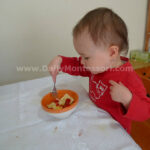
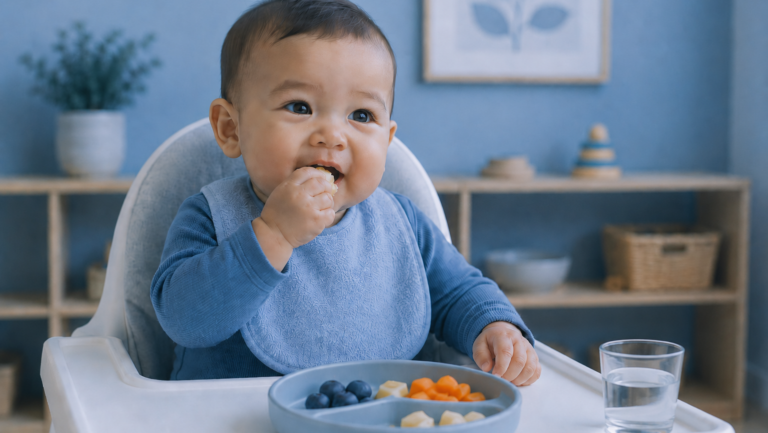
When having a meal with the child it is important to face him to give him respect in letting him know when the food is about to be given. Giving the child a spoon in the early stages allows them to practice their grasping and later on attempt to feed themselves as they have seen it modelled by the adults. An adult may scoop the food for the child leave it in the bowl and the child may take it from the bowl to place in the mouth. This will allow the child to have independence. Also allow the child to have finger foods such as rice crackers and bread or even soft fruits.

When having the first meal it is important to make it an enjoyable experience not hurried and choose a convenient time. Respect the child’s choice to eat or not to eat. Have a table that is beautiful with a placemat, utensils and even flowers. The child can also be given a small glass of water (shot glass) during meals.


*Note - Recommendations on breastfeeding from some of the organisations

The American Academy of Pediatrics (AAP)
“The AAP recommends that babies be exclusively breastfed for about the first 6 months of life. This means your baby needs no additional foods (except Vitamin D) or fluids unless medically indicated. Babies should continue to breastfeed for a year and for as long as is mutually desired by the mother and baby.”
Source: http://www.aap.org/breastfeeding/faqsBreastfeeding.html

The Australian Breastfeeding Association (ABA)
“When to wean - This is a very personal decision, which must take into consideration the needs of baby and mother, as well as the home and family situation. You may want to, or you may have to, wean early. Try to make it gradual if this is the case. On the other hand, you may want to wean later - into your baby’s second year, or later. Ideally it is best not to set a time limit for weaning unless it is absolutely necessary.”
Source: http://www.breastfeeding.asn.au/bfinfo/weaning.html

World Health Organisation (WHO)
“WHO recommends - WHO strongly recommends exclusive breastfeeding for the first six months of life. At six months, other foods should complement breastfeeding for up to two years or more.”
Source: http://www.who.int/features/factfiles/breastfeeding/facts/en/index.html

Add comment


Comments  

 
#6 Taleena 08-Dec-2012
This does upset me as well. I completely agree with Angela. Babies are born with an open gut, and introducing solids before the gut is sealed can lead to Leaky Gut and cause lifelong illnesses, most of which are not reversible. Babies should not receive any solids at all before 6 months, and breastfed babies should still be getting 80-90% of their nutrition from breastmilk. At 18 months, 50% of their nutrition should come from breastmilk, and at 2 years of age, 80-90% of their nutrition should come from solid foods. Also, the specific recommendations for which foods to offer are very out-dated. It is recommended not to give eggs before 1 year of age. Egg whites are more prone to cause allergic reactions, so it is fine to hard-boil the egg and offer yolk only around 10-11 months. Also, infants do not have the enzymes needed to process grains until at least 12 months. Brown rice or juice are horribe suggestions for first food experiences. Commercial juice is very high in sugar. Also, no dairy products should be introduced before 12 months of age. I fully respect many aspects of Dr. Montessori's teaching, but most of this information is out-dated due to scientific advances and greater understanding of nutrition. Also, before 1 year of age, solid foods are given as practice, only so that the child can experience the taste and texture. A breastfed baby should always be breastfed before solids are offered, and a serving of solid foods should not be more than a few tablespoons. I am glad to see that you have at least added some information from reputable medical organizations, but I highly suggest updating this with even more scientific research, so that people can make more of an educated decision, and understand why things were different during that time than they are now.
Quote
 
 
#5 Paulene 26-Aug-2012
As an AMI trained Montessorian I am really disappointed to see that AMI is still publishing information about breastfeeding and weaning which is contrary to modern research. Such persistence does nothing for the reputation and credibility of Montessori education. I am relieved to see that you have at least acknowledged the WHO recommendations .
Quote
 
 
#4 Lorrienne 05-Mar-2011
My granddaughter is 6 months old and I found this website very informative. Thanks for a great read.
Quote
 
 
#3 valencia 13-Jan-2011
i have wait up to 6 months old to start weaning my son. I have started with puree but he never want to swallow anything solid. He is now 26 months old he still do not want solid food. What do you advise me.
He only drink milk in his feeding bottle, and he sometime eat smash potato. However he eat biscuits, snacks, cakes etc but he do not approve meal that we have.
Please help . . .
Quote
 
 
#2 DM Moderator 06-Jun-2009
Hi Angela,
Thank you for your comment. We’ve included additional information from AAP, ABA and WHO.
Quote
 
 
#1 Angela 05-Jun-2009
I would urge others to note that although these recommendations fit with the philosophy of Maria Montessori, they are contrary to modern research and the World Health Organization’s current recommendations . The World Health Organization recommends exclusive breastfeeding until at least six months of age and that breastfeeding continue beyond the age of two years.
Quote