
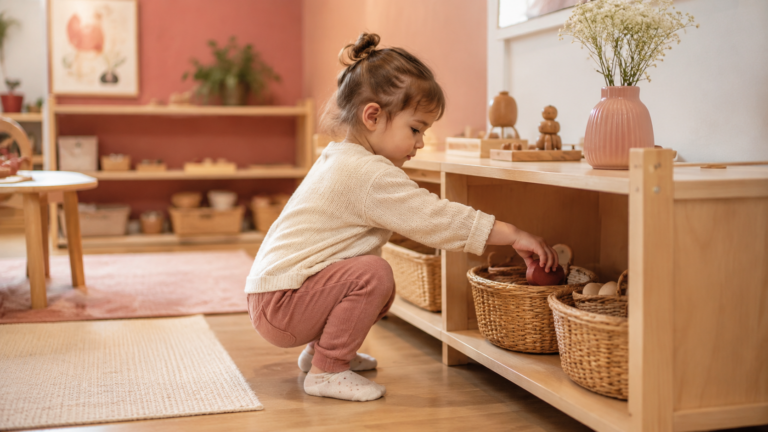
The sensitive period for order begins from birth and is thought to peak between approximately 18 months and 2.5 years, continuing to around age five. During this time, many children show a strong desire for consistency, routine, and predictability. They may become noticeably upset when things are out of their expected place, or when familiar routines change unexpectedly.
What can sometimes appear as stubbornness or excessive upset over small things — sometimes associated with the “terrible twos” — may often be understood as a child’s sensitive period for order expressing itself. A cup placed in the “wrong” spot, a familiar route home changed, or a routine disrupted can genuinely feel significant to a child in this period.
Why Order Matters for Development
Montessori observed that external order helps children develop internal order — a sense of how the world works, how things are organised, and where they fit within it. A predictable, well-arranged environment may support children in feeling calm and secure, freeing their attention for exploration and learning.
Supporting This Period at Home
- Create consistent places for objects your child uses regularly — their cup, their shoes, their materials.
- Keep routines as predictable as reasonably possible — particularly around mealtimes, naps, and bedtime.
- Where changes are unavoidable, consider giving advance notice in simple terms: “After lunch, we’re going to do something different today.”
- Involve your child in tidying and returning things to their place — this reinforces both order and independence.
Other Montessori Sensitive Periods
- Sensitive Period for Language (birth to 6 years)
- Sensitive Period for Movement (birth to 4 years)
This post is intended for general informational purposes only; please consult a qualified professional for advice specific to your child’s individual needs.
0.5
Over short of words when I saw the site. it has help me on my foundation stage.
thanks
I am not sure that I understood the sensitive period of order properly. what I understood is this period is where a Child orders himself by what he sees the adult and other children doing. after the meal the child takes his plate back to the kitchen , he washes his hands and dry them with a towel, using of potty as he is being taught, keeping his toys back to the right place after playing. he also dress and undressing himself. keeping his shoes back to the right place after entering in the house.
Thanx a lot! Much appreciated!
Hi!
Sad to say it is normal. She is about to go into her toddler years and that is to be expected. How to get her to share? That will definitely take time and a lot of patience and explaining on your part. A good thing to do is to be good role model and explaining why things are being done, keep it positive and recognise the specific act that she does when she decides to share as a reinforcement of good behaviour.
thanx a lot! Great site! My niece has become very possessive of her stuff or her mum’s and dad’s.Is she going through a sensitive period for order? Shes 17 months.She wont let anyone play with HER toys,and NO-ONE can carry HER mum’s/dad’s stuff. E.g.If her granny carries her mum’s bag-Its a problem.
Would appreciate any feedback/suggestions on how to get her to share and not be so possessive.Is this normal and is it a problem?
thanx
The lessons in order to teach order at this age is not learned through
a formal lesson. It is in the way of life or by example that the
child can learn order. It can be in the way that your daily routine is
accomplished. The way their room or your house is set up. Order can be
shown in the way a shelf is arranged with the child’s toys.
How to set the table the order it is always done. for us it does not
which goes 1st for children it does. Keep all the things always a
constant place. Where the books are, where to sleep, where to bath,
where to play and where his toys are kept. In a Montessori classroom
this si ingrained in all the activities that have been set up. There
is a strict order of ways to do things that help the child understand
order. For example with washing hands, always wet the hands first,
soap and lather until the bubbles come and then rinse and do not
forget to dry the hands. it is in that simple activity that all adults
know but need to be conscious to make it consistent and ordered when
around your children. When setting up their things for brushing their
teeth in a tray always order things in a tray in order of use from
left to right. Like have the toothbrush in the leftmost, the
toothpaste then the glass for the water.
In their room make sure the books are all in one area all the time,
and the similar toys together in a shelf.
An ordered environment helps the child internalise this sense of
order. It is in these small things we can do around their environment
that helps these children in this age group learn about order.
Hope this gives you a better understanding and an idea of what things
you can do around your home.
wt are the things that children of this age bracket can be taught.