
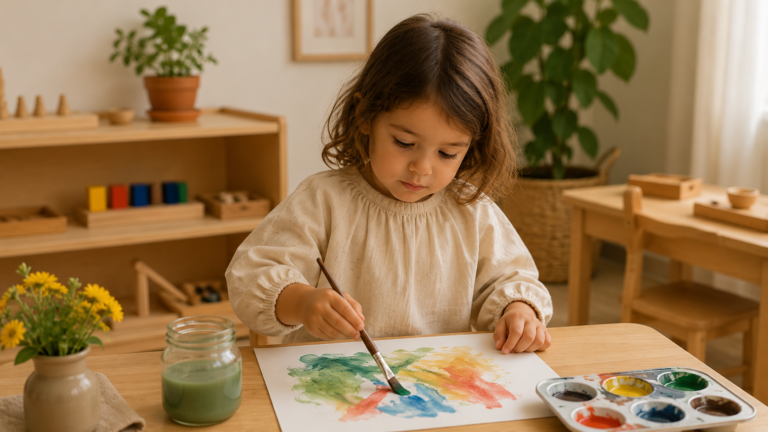
Creativity and Children
Creativity is sometimes thought of as the domain of artists and performers, but its value extends well beyond the arts. Research has suggested links between creativity and problem-solving ability, flexible thinking, and the capacity to approach challenges in new ways. Nurturing creativity in young children may support development across many areas of their lives.
One perspective describes creativity as “an attitude that comes easily to the young, but must be sustained and strengthened lest it be sacrificed in our too logical world” (Marzollo and Lloyd, 1972). This framing reminds us that creative capacity is something children are often born with — and that our role is to protect and encourage it, not create it from scratch.
The Montessori View of Creativity
For Montessori, creativity is deeply connected to the process of self-discovery and self-expression. She saw it as involving three interrelated steps:
- What is out there? — Exploring and discovering the world
- What might I do with what is there? — Developing imagination and abstract thought
- How can I carry out my ideas? — Taking action and creating something new
In this sense, creativity is not just about drawing or painting — it is present in play, problem-solving, language, and the way a child approaches any open-ended task.
How to Support Creativity at Home
- Offer open-ended materials — things without a fixed “right” answer: clay, blocks, drawing materials, natural objects, fabric. These invite exploration rather than directing a single outcome.
- Protect uninterrupted time for child-led play. Creativity often emerges when children are not rushed or directed.
- Resist the urge to always show children how to use materials. Allow them to discover their own possibilities first.
- Value the process over the product — comment on what you observe (“You used lots of blue there!”) rather than judging the outcome (“That’s so good!”).
- Be creative yourself. Children are keen observers and often follow the lead of those they admire.
This post is intended for general informational purposes only; please consult a qualified professional for advice specific to your child’s individual needs.

1.5