
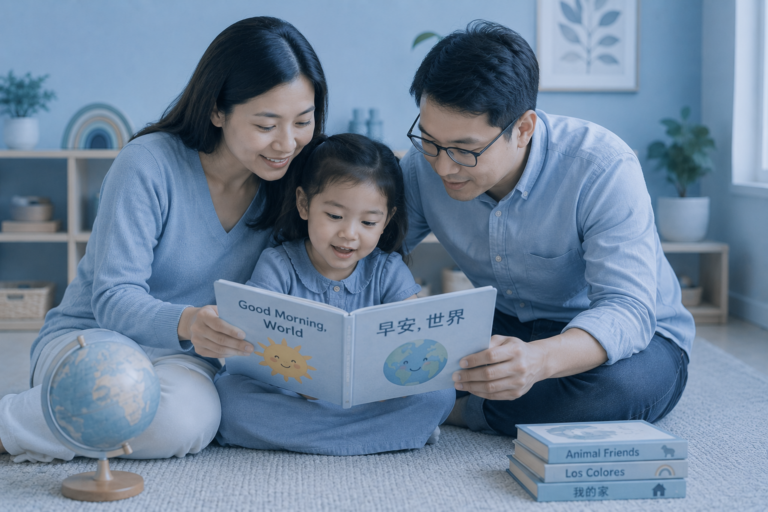
Raising Bilingual Children
As the world becomes increasingly connected, many families find themselves navigating two or more languages at home. Parents from different cultural backgrounds often want to pass on their language and heritage to their children, even when living in a country where a different language is spoken. This can raise an important question: how does one share the richness of their culture with the next generation?
Will Two Languages Confuse My Child?
A common concern among parents is that exposing a child to multiple languages may lead to confusion or delay language development. Current research generally suggests this is not the case. Studies have found that bilingualism is unlikely to cause significant language delays in young children, and in many instances exposure to more than one language may be beneficial.
Research suggests that children raised with two or more languages may develop advantages in areas such as creative thinking, communication, problem-solving, and cognitive flexibility. These benefits may continue to grow as the child develops and uses their languages in meaningful contexts.
The Montessori Perspective on Language
Maria Montessori observed that the sensitive period for language runs from approximately seven months in utero until around six years of age. During this time, young children have a remarkable capacity to absorb language naturally — a second or even third language can often be learned with relative ease when a child is immersed in it from an early age.
The Montessori approach encourages talking to children richly and consistently in whatever language or languages are part of the home environment. The key is genuine, meaningful communication — reading books, singing songs, narrating daily activities, and having real conversations all support language development in any language.
Practical Tips for Bilingual Families
- Consider a “one parent, one language” approach, where each parent consistently speaks their own language with the child.
- Read books and tell stories in both languages regularly.
- Do not worry if the child mixes languages — this is a normal and typically temporary part of growing up bilingually.
- Connect children with other speakers of their minority language where possible, such as through community groups or family visits.
- Be patient: some children may take a little longer to begin speaking, but this does not necessarily indicate a problem.
This post is intended for general informational purposes only; please consult a qualified professional for advice specific to your child’s individual needs.

Thanks alot for this great information. I am from Indonesia. I try to educate my youngest daughter english.
I’m German and my husband is english. My first child picked up both languages English and German very quickly. But my second child struggled with both languages. He just turned 5 and the speech therapist suggested to stick to English, because his speech is very much delayed. I’m worried, he suppose to start school this year but we kept him back till he is 6 years old
I am an American living in Korea with my 2 and a half year old son. My Korean language skills are very poor, but enpugh to generally get along. My son speaks English at home with me and his school is in Korean. Its very clear that he understands both. I do worry that we may be confusing him because there is a lot of language mixing. Thanks for this article. I will try to not mix in Korean at home and ask his teachers not to mix in English in school.
I am Spanish my Wife Russian and we leave in New Zealand. My wife and I communicate in English but we both speak in our mother language to our children. My son is just learning to speak but he seems to understand the 3 languages without problems. Is good to know that there are other parents with similar situations. I think speaking more than 1 language is great. I personally speak 4 languages and has given me a great advantage.
My son is 20 months old and understands Polish (my mother thogue), Spanish (his dad’s and our language spoken at home ), and French, problably also some English, as we live in Montreal and are exposed to both of them. I am very happy about his language skills, although he doesn’s speak much yet, but it is clearly visible in different situations with different people that he understands very well all languages mentioned above. I am a multilingual person myself, but I had to put lots of effort in learning all of my five languages (3 of them at the native speaker level, 2 others very good), which I would like my son to avoid… Now, he’s learning naturally, which is the best way.
I agree with Tatyana that teaching your mother tongue to your child, you give the the best gift ever!
Greeting,
PaniTanguera
My twin daughters are 3,5 now. I am Russian and my husband is English. I made sure from very beginning that I spoke Russian to girls. It is hard at times as my husband doesn’t speak any Russian so he found it very frustrating at times and worried a lot that their English wouldn’t be as good as Russian as they spent more time with me. That proved to be silly as they now speak both very well in both languages. They only mix it up mainly when they speak to each other but do know exactly what words to use for me and their father. They go to British school, so now I worry more that they will prefer to use English as we live in English speaking community. Hope I will be strong enough to carry on! It is the best gift one can give to a child for their future.
I AM A TEACHER OF ENGLISH WITH ONE SON. 2 YEARS AGO WE’VE JUST MOVED FROM MY HOME TOWN. HE IS NOW 4 YEAR OLD BOY. WE AT HOME SPEAK BOTH MOTHER LANGUAGE AND INDONESIAN. HE SPEAKS INDONESIAN WITH HIS LITTLE FRIENDS AND HE UNDERSTANDS WHEN WE THE PARENTS SPEAK THE MOTHER LANGUAGE TO HIM AND REPLY IN THE SAME LANGUAGE. I LIKE TO PRACTICE SPEAKING ENGLISH AS WELL AT HOME.
I am an American having recently moved to the middle east. My daughter is 3 and in just 4months time is speaking Arabic outside the home and English inside. She also seems to know which people speak which language and never confuses the two. Remarkable!
It is interesting to know that the use of local language or mother tongue alongside with community language has no negative implication on the child.